
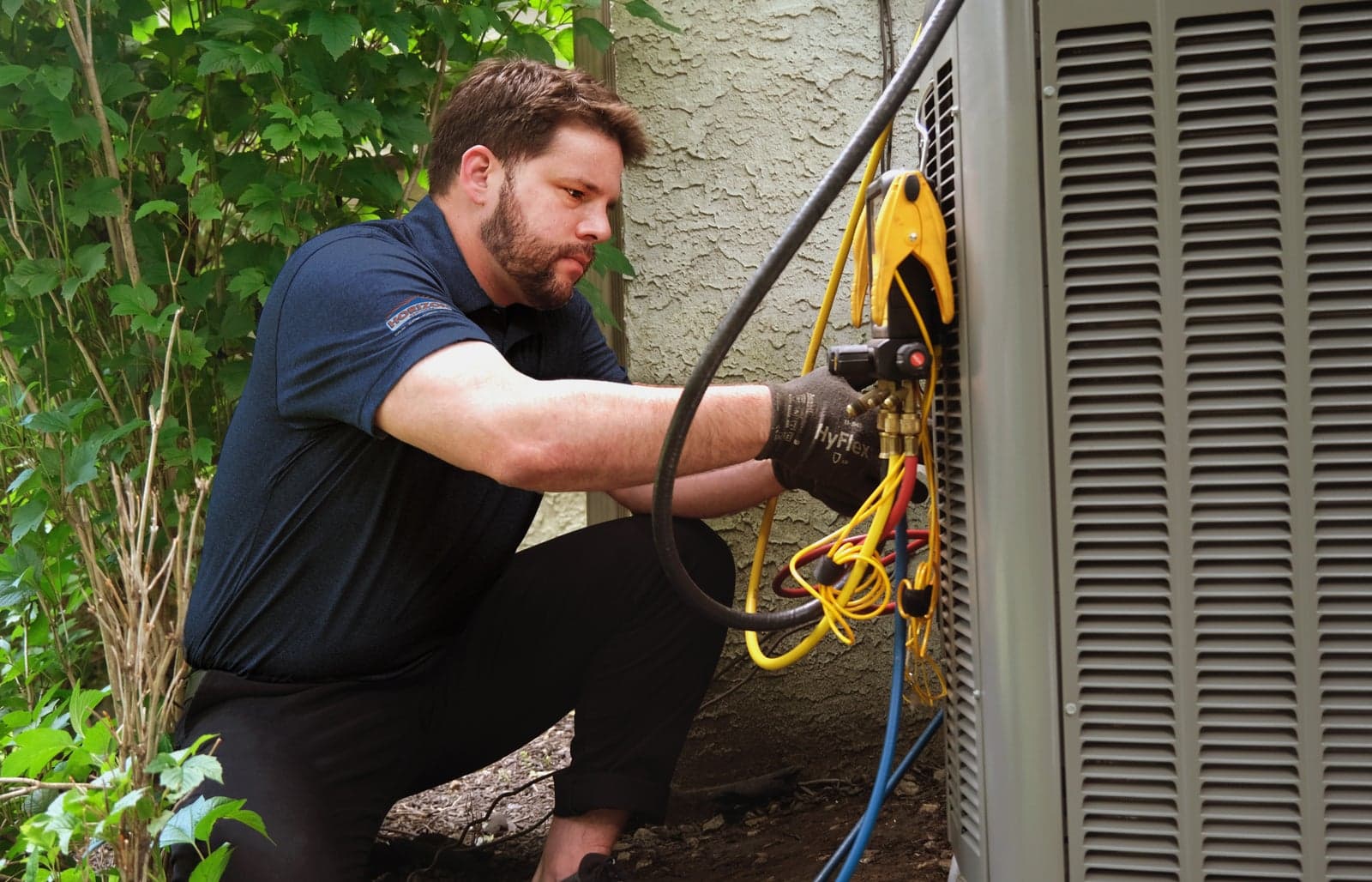
Brand matters, but far less than most people shopping for an air conditioner expect. Carrier, Trane, Lennox and every other major manufacturer build equipment capable of fifteen years or more, and all of them fail early when the system is oversized, charged wrong or connected to bad ductwork. What actually decides lifespan is sizing, installation and commissioning quality, and who services it afterward.
On this page:
What actually decides lifespan
Where brand does make a difference
What Horizon actually installs
System choices that matter more than the badge
Decision factors and how to verify them
Questions to ask before you sign
FAQs
Almost every air conditioner conversation starts in the wrong place. A homeowner opens three tabs comparing Carrier, Trane and Lennox, reads a dozen contradictory rankings, and comes away convinced the decision is a badge.
Meanwhile the two variables that will genuinely determine whether that system reaches year eight or year eighteen never come up, because neither one appears on a spec sheet.
What Actually Decides How Long a System Lasts
These are in order of impact.
Correct Manual J Sizing
Manual J is the load calculation that determines what size system a specific house needs, based on its square footage, insulation, window area, orientation and air tightness. It is not a rule of thumb about tons per square foot, and it is not the size of the unit currently sitting in the yard.
Oversizing is the most common and most expensive mistake in residential HVAC. An oversized air conditioner satisfies the thermostat quickly, shuts off, and starts again a few minutes later. Those short cycles never run long enough to pull humidity out of the air, so the house feels clammy at 72 degrees, and every start-up is the hardest moment in a compressor's life. A system that starts twice as often ages roughly twice as fast.
Installation and Commissioning Quality
A correct install is a series of measurements, not a series of connections.
The line set has to be evacuated to a proper vacuum before refrigerant goes in, because moisture left in the lines forms acid and eats the compressor from inside. The charge has to be verified by measurement against the manufacturer's target, not estimated. Airflow has to be set to the equipment's specification rather than left wherever the blower tap happened to be.
Ask for those startup numbers in writing. A contractor who takes them will hand them over. A contractor who does not take them will change the subject, and that answer tells you what you need to know.
Duct Condition and Design
New equipment connected to undersized, leaky or badly balanced ducts inherits every problem the old system had. Duct leakage in an unconditioned attic or crawl space throws away conditioned air you paid to make, and it starves the coil of the airflow the equipment was designed around.
If two proposals differ sharply and only one mentions ductwork, that is usually the difference.
Who Honors the Warranty
Manufacturer parts warranties are broadly similar across the major brands, and most of them require registration within a window after installation or the term drops. The part of the warranty that actually costs money is labor, and labor is covered by the contractor, not the manufacturer.
So the question worth asking is not whose warranty is longer. It is who files the claim, who does the labor, and whether that company will still be answering the phone in year nine.
Local Parts and Service Availability
A compressor or control board that has to be ordered from three states away turns a one-day repair into a week without cooling in August. Depth of local parts stocking varies by brand and by region, and it is a fair question to ask any contractor about the specific equipment they are proposing.
Annual Maintenance
Coil cleaning, condensate management, electrical connection checks and charge verification are unglamorous and they are what separates a system that dies at year ten from one that runs past fifteen. A dirty condenser coil raises head pressure and shortens compressor life on any brand you can name.
Where Brand Does Make a Real Difference
Refusing the question entirely would be its own kind of dishonesty, so here is where the badge genuinely matters.
It matters in how deep the local dealer and parts network runs for that brand in your area, which determines repair turnaround. It matters in how the manufacturer administers registration and warranty claims, since some make it straightforward and others do not. And it matters in how long parts stay available after a model is discontinued, which is the difference between repairing a twelve-year-old system and replacing it.
All three are local questions with local answers. None of them is settled by a national ranking article.
What Horizon Actually Installs
You should know where we stand before you weigh any of the above.
Horizon Services installs Daikin and Rheem equipment, and we are not a Carrier, Trane or Lennox dealer. We repair and maintain all makes and models, including all three of those brands, which is how we see what fails and why across the whole field rather than just our own.
That is also why this article does not pick a winner. We would have an obvious interest in doing so, and it would not make the answer any more true. You can see the equipment lines we install if you want the full list.
System Choices That Matter More Than the Badge
These four decisions will affect your comfort and your bills more than choosing between two comparable premium brands.
Single-Stage vs. Two-Stage
A single-stage compressor runs at full output or not at all. A two-stage compressor holds a lower first stage most of the season and only steps up when it has to.
Longer runtimes at lower output mean steadier temperatures between rooms and far more moisture pulled out of the air. In a Mid-Atlantic July, humidity is what people actually notice, and it is the reason a two-stage system at the same thermostat setting feels meaningfully more comfortable.
Air Handler vs. Furnace
Both push conditioned air through the same ducts and both house the indoor coil. A furnace burns gas, oil or propane and contains the blower. An air handler has no burner: it holds the coil, the blower and usually an electric backup element, and it pairs with a heat pump.
The rule is simple. Your heat source decides which one you have, not your air conditioner. Gas heat means a furnace; a heat pump means an air handler.
Central Air vs. Window Units
A central air system conditions the whole house from one outdoor unit, runs quieter, dehumidifies properly, and typically lasts about twice as long as a window unit. Window units cool one room each and get installed, pulled and stored every year.
Window units win in exactly one scenario: occasional cooling of one or two rooms. For a whole house, several window units running independently cost more to run and condition the house worse. Where ducts do not exist, a ductless mini split is usually the better answer than a window unit.
Geothermal vs. Air-Source Heat Pumps
Geothermal exchanges heat with the ground, so its efficiency barely moves when outdoor air hits design temperature. That stability is real and so is the constraint: it needs a loop field or wells, and on most lots in our service area the lot itself is the limiting factor rather than the budget.
An air-source heat pump needs no excavation, and current cold-climate models hold useful capacity well below freezing in this region.
Heat Pump vs. Furnace and AC
Total ownership cost comes down to four things: what you pay for electricity versus gas locally, how well the house holds heat, whether the installation is sized and commissioned correctly, and what incentives are actually available when you buy.
On that last point, be careful with anything you read that was written before this year. The federal 25C and 25D tax credits terminated for property placed in service after December 31, 2025, under PL 119-21, so a federal credit is not part of the math on a system installed now. Utility and manufacturer programs are where current incentives live, and those change often enough that they should be confirmed at the time you buy rather than taken from an article. Our current offers and rebates page is kept up to date.
Decision Factors and How to Verify Them
Here is the whole argument in one block.
Decision factor | Why it matters | How to verify it |
Manual J load calculation | Oversizing causes short cycling, poor dehumidification and early compressor wear | Ask to see the calculation, not a rule of thumb or the old unit's size |
Line set evacuation | Moisture left in the lines forms acid and attacks the compressor | Ask what vacuum level they pull to and how they confirm it holds |
Refrigerant charge | Wrong charge costs capacity and shortens compressor life | Ask for the measured startup readings in writing |
Airflow setting | Wrong airflow starves the coil and unbalances the house | Ask what CFM they set and against which specification |
Duct condition | Leaky or undersized ducts undo new equipment immediately | Ask whether ducts were inspected and what the proposal includes |
Warranty registration | Most manufacturer terms shorten if registration is missed | Ask who registers it and by what date |
Warranty labor | Parts are covered by the manufacturer, labor is covered by the installer | Ask who performs warranty labor and for how long |
Local parts availability | Determines whether a failure is a one-day or one-week repair | Ask whether common parts for that model are stocked locally |
Maintenance plan | Coil and charge condition drive lifespan more than brand does | Ask what an annual visit includes, item by item |
If you would rather have those answers than a brand ranking, we will bring them to you. Call 1-800-642-4419 for a load calculation and a written proposal.
Questions to Ask Before You Sign
Read these out loud in the appointment. The answers separate contractors faster than anything else you can do.
Did you perform a Manual J load calculation for this house, and can I see it?
What airflow will you set, and against which specification?
What are the startup readings, and will they be written on the invoice?
Was the ductwork inspected, and is any duct work included in this proposal?
Who registers the manufacturer warranty, and by when?
Who performs warranty labor, and for how long is it covered?
Are common parts for this model stocked locally?
Our list of questions to ask an HVAC contractor goes further if you want more. And if the system you have is still running, it may be worth deciding whether to repair or replace the system you have before you shop at all.
Why Choose Horizon Services
We install Daikin and Rheem, we service every major brand including the ones we do not sell, and we would rather size and commission a system correctly than sell you a badge. Our air conditioning services cover repair, maintenance and AC replacement across Delaware, southeastern Pennsylvania, South Jersey and parts of Maryland, including Newark and the rest of New Castle County.
For AC repair or a replacement proposal, call 1-800-642-4419.
Does AC Brand Matter FAQs
Carrier vs Trane vs Lennox, which AC brand lasts longest?
No independent evidence shows one of those brands consistently outlasting the others. Across every major manufacturer, lifespan tracks correct Manual J sizing, refrigerant charge verified at commissioning, duct condition and annual maintenance far more than the badge. Horizon Services installs Daikin and Rheem equipment and services all makes and models.
Two stage vs single stage AC, what's the difference for comfort?
A two stage air conditioner is noticeably more comfortable because it runs longer at lower output instead of blasting and shutting off. Longer runtimes even out temperature between rooms and remove far more humidity. A single stage unit cools faster but leaves the air damper and the house less evenly conditioned.
Air handler versus furnace as the indoor unit, what's the difference?
A furnace burns fuel and includes the blower; an air handler has no burner and pairs with a heat pump. Both circulate air through the same ducts and both house the indoor coil. Which one you have is decided by your heat source, not by your air conditioner.
Central air vs window units, which is cheaper long term?
Central air is cheaper over the long run for a whole house. One correctly sized system conditions every room more efficiently than several window units running independently, dehumidifies properly, and typically lasts roughly twice as long. Window units win only when you are cooling one or two rooms occasionally.
Geothermal versus air source heat pump for year round comfort?
Both deliver year-round heating and cooling; the difference is where they get their heat. Geothermal pulls from stable ground temperature, so output holds steady in extreme weather, but it requires a loop field or wells. An air source heat pump needs no excavation and performs well in Mid-Atlantic winters.
Heat pump versus furnace and AC combo, what decides total ownership cost?
Local electricity and gas rates, how well the house holds heat, whether the install is sized and commissioned correctly, and what incentives apply when you buy. The federal 25C and 25D credits terminated for property placed in service after December 31, 2025, so current incentives come from utility and manufacturer programs instead.
Who should I call for AC repair in Newark, DE?
Horizon Services handles AC repair in Newark, Delaware with same-day appointments and no added fee for evenings, weekends or holidays. Technicians carry common failure parts including capacitors, contactors and blower motors, so most no-cooling calls in Newark are diagnosed and repaired on the first visit.
Related Articles
What do you need help with today?
Heating
No heat, strange smells, rising bills? We repair and replace heating systems to keep your home reliably warm.
Air Conditioning
AC blowing warm air? Uneven cooling in your rooms? We fix cooling issues fast and keep your system running smoothly all summer.
Plumbing
Our highly trained plumbers handle it all, from leaky faucets to full system installations and repipes.
Electrical
The smartest team in town. You need repair, installations, wiring, inspections, lighting — you name it.