
What a Water Heater Replacement Actually Includes: Pans, Expansion Tanks, Permits and Code Upgrades
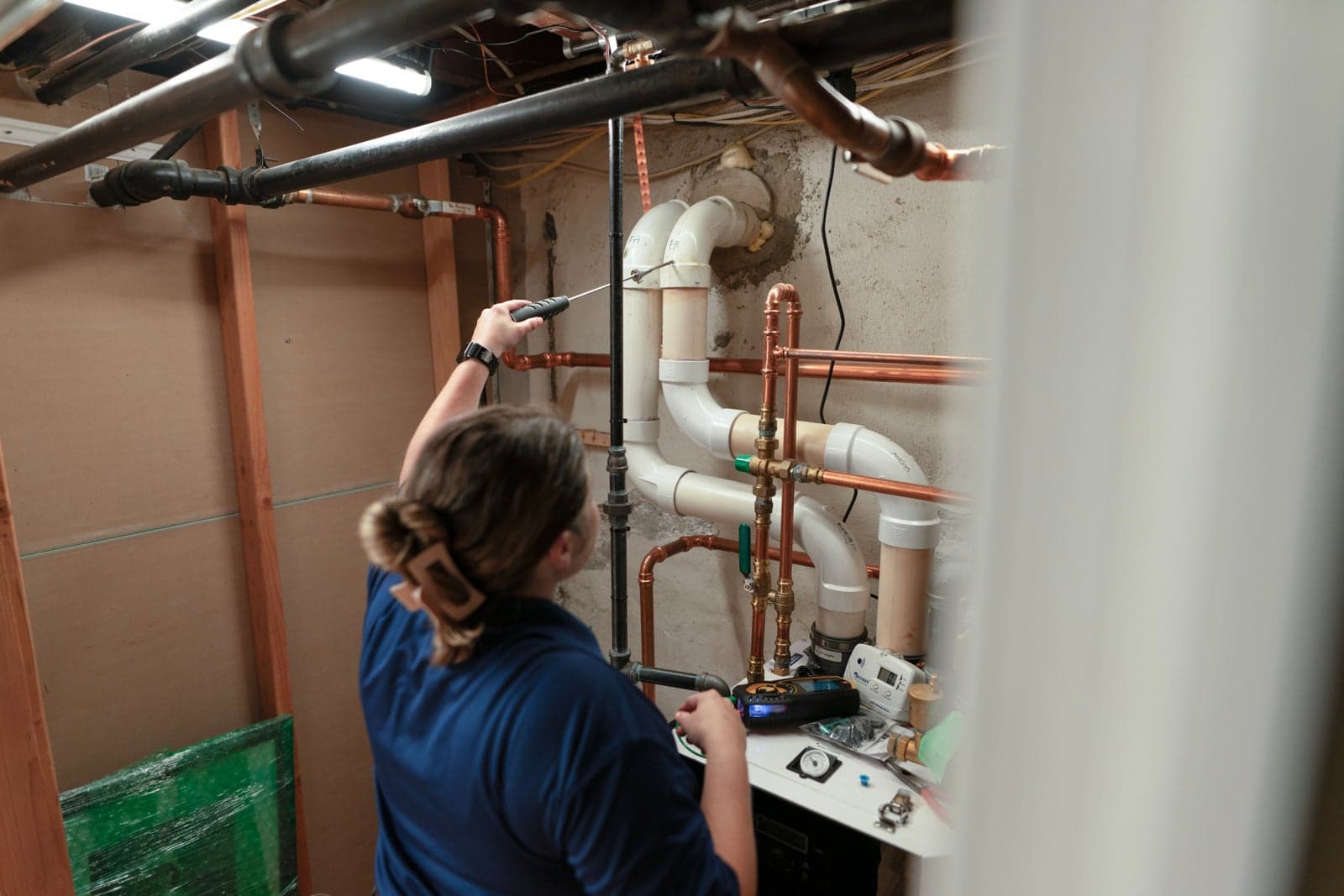
A water heater replacement is rarely a straight swap, because the new installation has to meet current code even though the old one did not. Depending on your house, that can add a drain pan and drain line, a thermal expansion tank, corrected relief valve discharge piping, venting or combustion air work, and a permit with a final inspection. None of those are upsells. They are what the inspector checks.
On this page:
What a complete replacement includes
What triggers each upgrade
How long the installation takes
Permits and what the inspector checks
What the written quote should name
Replacing one yourself
FAQs
The most common complaint we hear about water heater replacement has nothing to do with the water heater. It is that the final invoice contained three items the homeowner had never heard of.
That is a communication failure rather than a pricing one. The items are real, most of them are required, and almost all of them are predictable from things you can see in your own basement before anyone gives you a number.
So here is the whole scope, item by item, and what makes each one apply to your house rather than to the house next door.
What a Complete Replacement Includes
Not every item below applies to every install. Each one has a specific trigger, and the triggers are named.
Drain Pan and Drain Line
A pan is required wherever a leak would damage the structure or finished space below. In practice that means any unit in a finished basement, a closet, an attic or on an upper floor.
The pan also needs to go somewhere. A pan sitting under the tank with no drain line just holds water until it overflows, and that fails inspection. It gets piped to a floor drain, a sump or the exterior.
Thermal Expansion Tank
Water expands when it is heated and it cannot be compressed. In an open system that expansion pushes harmlessly back toward the street.
If your home has a backflow preventer, a pressure reducing valve or a check valve on the incoming line, the system is closed and that pressure has nowhere to go. It spikes on every heating cycle, which is hard on the tank, the relief valve, toilet fill valves and appliance solenoids.
Most homes on municipal water in our service area now fall into that category, which is why this is the item that surprises homeowners most often. It applies to replacements, not just to new construction.
Relief Valve Discharge Piping
The temperature and pressure relief valve is the last safety device on the tank, and it needs a full-size discharge pipe running to a location where a release would be visible and safe.
Older installs routinely have the wrong pipe size, the wrong material, a valve on the end of the pipe, or a termination pointed somewhere nobody would ever notice. All four get corrected on a replacement.
Combustion Air and Venting
A gas water heater has to draw enough air to burn correctly and vent the products of that combustion safely outside.
Dropping a new unit into a tight closet or a small mechanical room can require added combustion air, a resized vent, or a change in vent material. This is the single most common reason a same-day swap turns into a two-visit job, and it is worth knowing in advance rather than at four in the afternoon.
Stands, Strapping and Clearances
Garage installations generally need the burner elevated or a sealed combustion unit. Closet installations need enough service clearance that a technician can actually reach the anode rod and the drain valve, which is the difference between a unit that gets maintained and one that does not.
Thermostatic Mixing Valve
A mixing valve lets the tank store water hotter while delivering a safe temperature at the tap. It is the correct answer when water scalds even at the lowest heater setting, and it is also how you get more usable hot water out of the same size tank.
It can be added on a replacement or, on most existing units, during a scheduled maintenance visit.
Permit, Inspection and Haul-Away
Water heater replacement is permitted work in most municipalities across our footprint. We pull the permit, meet the inspector and take the old tank with us.
What Triggers Each Upgrade
Look at your own installation against this table before you call anyone. It will tell you most of what your quote is going to contain.
What is true about your house | What it triggers | Why |
Water heater in a finished basement, closet, attic or upper floor | Drain pan and a piped drain line | A leak would damage finished space below |
Backflow preventer, pressure reducing valve or check valve on the incoming line | Thermal expansion tank | Closed system; heated water has nowhere to expand |
Municipal water service | Usually an expansion tank | Most municipal services in our area are now closed systems |
Relief valve pipe smaller than the valve outlet, or made of the wrong material | New discharge piping | It is the tank’s last safety device and has to flow freely |
Gas unit in a small closet or tight mechanical room | Combustion air provisions | The burner needs air to burn correctly |
Switching to a higher efficiency or a tankless unit | New venting, often new material | Different flue temperatures and different vent rules |
Tankless conversion | Gas line sizing check, condensate drain, electrical supply | Much higher instantaneous gas demand than a tank |
Gas unit in a garage | Elevated burner or a sealed combustion unit | Ignition source clearance from the floor |
Water scalds at the lowest setting | Thermostatic mixing valve | Lets the tank store hot while delivering safe |
Hard water and no softener | Sediment management and more frequent flushing | Scale shortens tank life and reduces capacity |
Bathroom addition planned | Capacity and recovery sizing now, not later | Cheaper to size once than to replace twice |
Any replacement | Permit and final inspection in most jurisdictions | New work is held to current code |
How Long the Installation Takes
A like-for-like tank swap in an accessible basement is a same-day job, usually a single morning or a single afternoon.
It becomes a longer day or a second visit when you add a tankless conversion, a vent change, a gas line resize, a new expansion tank, or a location tight enough that the old tank has to come out sideways.
Next-day installation is generally available across our service area, and we stock Rheem and our other preferred lines rather than ordering equipment after the quote is accepted.
The commitment worth asking any contractor for is not a duration. It is that the timeline gets confirmed at the estimate rather than announced on arrival.
Permits and What the Inspector Actually Checks
Water heater replacement is permitted work in most municipalities across Delaware, southeastern Pennsylvania, South Jersey and parts of Maryland. The rules are set locally rather than statewide, and the adopted plumbing code edition differs not only between those states but sometimes between neighboring townships.
That is why your neighbor’s experience is not evidence about yours, and why a page like this one cannot be the final authority for your address. Your local code office is.
What the inspector looks at is consistent even where the code edition is not. Venting and combustion air. Relief valve discharge size, material and termination. Expansion control on a closed system. Pan and drain where finished space is below. The gas connection and any required shutoff. Clearances around the unit.
One visit after the work is complete is the normal case.
Horizon pulls the permit and meets the inspector. If a contractor asks you to pull the permit for work they are performing, that is worth a second thought, because a homeowner permit generally carries a declaration that you did the work yourself.
What the Written Quote Should Name
Two quotes for the same water heater can look very different, and the difference is almost never the water heater. It is what each one includes.
Run any proposal against this list. Anything not named on it is not in the price.
Unit make, model and capacity, not just “50 gallon gas”
Drain pan and drain line, if your location calls for one
Thermal expansion tank, if your system is closed
Relief valve discharge piping
Venting work, including any change of material
Gas or electrical work, including any line resizing
Permit and final inspection, and who pulls it
Removal and disposal of the old tank
Warranty terms broken out separately for the tank, the parts and the labor.
If a quote is silent on the expansion tank and your house has a pressure reducing valve, you have not found a better price. You have found a quote that is going to change.
Want a written estimate that itemizes all of this before anyone touches anything? Horizon Services provides free estimates for water heater replacement across Delaware, southeastern Pennsylvania, South Jersey and parts of Maryland. Call 1-800-642-4419.
Should You Replace a Water Heater Yourself?
Replacing a tank yourself is legal for a homeowner in parts of our service area, and it is still usually the wrong call.
Not because the plumbing is difficult. The water connections are the easy part, and a competent DIYer can make them.
The failure modes are combustion and pressure errors, and they are silent. An undersized relief discharge that cannot flow when it needs to. A vent that spills flue gas into the room instead of outside. A closed system with no expansion control, quietly stressing everything downstream. A pan with no drain.
Those four are exactly what the inspector checks, and they are exactly what fails a homeowner install years later when the house goes on the market.
There is also the practical part. A full tank weighs several hundred pounds, it comes out of a basement the same way it went in, and a gas connection that is not leak-tested is not finished.
What is reasonable to do yourself. Flushing sediment annually. Testing the relief valve. Checking the anode rod if it is accessible. Relighting a standing pilot on a unit designed for it, following the instructions on the label. If that pilot will not stay lit, stop; that is a thermocouple or gas valve fault rather than a relighting problem, and repeatedly relighting it is not fixing anything.
If you ever need to shut the unit down in a hurry, our emergency water heater shutdown procedures walk through it.
What Happens to the Old Tank
We take it. That is part of a complete replacement, and it should be a named line on any quote you accept.
If you are considering handling it yourself, know what that involves. The tank has to be fully drained, which takes longer than people expect on a unit full of sediment, then moved out of wherever it is without damaging a stairway, then delivered to a scrap yard or a municipal facility that accepts it. Rules on that vary by county across our footprint.
Why Choose Horizon Services for Water Heater Replacement
We pull the permit and meet the inspector on every job that requires one, across all four states we serve. On a job where most of the scope exists because of code, that is the part that matters.
We quote the whole scope in writing before the work starts, including the items above that depend on what is already in your basement, so the number you approve is the number at the end.
We stock our preferred lines rather than ordering after the fact, which is what makes fast turnarounds possible when a tank fails on a Friday. If yours has already failed, emergency plumbing service is available, and if you are still deciding between systems, tank versus tankless water heaters covers that choice in detail.
See all of our water heater services, or call 1-800-642-4419. Serving Delaware, southeastern Pennsylvania, South Jersey and parts of Maryland.
Water Heater Replacement FAQs
Does a replacement water heater need a drain pan, and where does it go?
A drain pan is required any time a leak would damage finished space below, which covers most basements, closets, attics and upper floor installations. The pan must be piped to a floor drain, a sump or the exterior rather than left to catch water on its own. A pan with no drain line fails inspection.
Is a water heater expansion tank required with a new install?
Yes, whenever the home has a closed water system. If there is a backflow preventer, a pressure reducing valve or a check valve on the incoming line, heated water has nowhere to expand and pressure spikes every cycle. Most municipal water homes in our service area need one, and it is added during the replacement.
Will replacing my old water heater trigger code upgrades?
Usually yes, and that is normal rather than an upsell. A replacement has to meet current code even when the original did not, so expansion tanks, drain pans, relief valve discharge piping, venting and combustion air often get corrected at the same time. Ask for these as named lines on the written quote.
How long does a water heater installation take?
A like-for-like tank replacement in an accessible basement is a same-day job, usually a single morning or afternoon. Tankless conversions, vent changes, gas line resizing or a tight closet location extend it to a full day or a second visit. We confirm the timeline at the estimate, not on arrival.
Can I replace a water heater myself, or is that a bad idea?
It is legal in parts of our service area and usually still the wrong call. The risks are not the water connections, they are combustion and pressure: undersized relief discharge, a vent that spills flue gas indoors, a closed system with no expansion control, and a pan with no drain. Those four fail inspection and fail at resale.
Can a plumber add a mixing valve during a maintenance visit?
Yes, a thermostatic mixing valve can usually be added during a scheduled maintenance visit on an existing tank. It is the right fix when water scalds even at the lowest setting, because it lets the tank store hotter water for capacity while delivering a safe temperature at every fixture.
Related Articles
What do you need help with today?
Heating
No heat, strange smells, rising bills? We repair and replace heating systems to keep your home reliably warm.
Air Conditioning
AC blowing warm air? Uneven cooling in your rooms? We fix cooling issues fast and keep your system running smoothly all summer.
Plumbing
Our highly trained plumbers handle it all, from leaky faucets to full system installations and repipes.
Electrical
The smartest team in town. You need repair, installations, wiring, inspections, lighting — you name it.