Quick answer: Reverse osmosis (RO) is a water treatment process that uses household water pressure to push water through a semi-permeable membrane. The membrane lets water molecules pass while holding back dissolved salts, lead, chlorine, and many other contaminants, which are flushed down the drain. Most reverse osmosis systems for the home sit under the kitchen sink and pair the membrane with sediment and carbon filters for cleaner drinking water.
On this page:
What is reverse osmosis?
Osmosis vs. reverse osmosis
How a reverse osmosis system works
What reverse osmosis removes
What reverse osmosis is used for
Is reverse osmosis water safe to drink?
Reverse osmosis vs. water filters
Pros and cons
Do you need a reverse osmosis system?
Under-sink vs. whole-house systems
What it costs
Maintenance schedule
DIY vs. professional installation
FAQs
Reverse osmosis comes up fast once you start asking what's in your tap water. It's one of the most thorough ways to treat drinking water at home. It also has trade-offs, and it isn't the right fit for every house.
This guide explains what reverse osmosis is in plain language, how a home system works, what it removes and what it misses, and how to tell whether your home needs one. Ready to talk about your water now? Horizon provides reverse osmosis water filtration services throughout Delaware, Southeastern Pennsylvania, South Jersey, and parts of Maryland. Call 800-642-4419.
What Is Reverse Osmosis?
Reverse osmosis is a water purification process that pushes water through a semi-permeable membrane under pressure. Water molecules pass through, while dissolved salts, metals, and other contaminants stay behind and are flushed away. It is the reverse of natural osmosis, which moves water toward the saltier side without added pressure.
In simple words: pressure forces water through an extremely fine filter. Clean water comes out one side, and the leftover contaminants go down the drain.
A semi-permeable membrane is a thin material that lets some molecules through and blocks others. In an RO membrane, the openings are small enough to hold back most dissolved salts and metals while water keeps moving.
Osmosis vs. Reverse Osmosis: What's the Difference?
Osmosis is a natural process. Reverse osmosis is the same process forced to run backward with pressure.
In osmosis, a membrane separates a weak solution from a concentrated one. Water naturally moves toward the concentrated side until both sides even out. The force behind that movement is called osmotic pressure.
In reverse osmosis, pressure is applied to the concentrated, contaminated side. Once that pressure is stronger than the osmotic pressure, water flows the opposite way, into the clean side, and the contaminants stay behind (University of Nebraska–Lincoln Extension).
Osmosis | Reverse osmosis | |
|---|---|---|
Energy needed | None; it happens on its own | Pressure, usually from your home's water pressure |
Direction of water flow | Toward the concentrated side | Away from the concentrated side |
Result | Both sides even out | Clean water on one side, concentrated waste on the other |
Where you see it | Plant roots, cells in the body | Drinking water treatment, desalination |
Think of osmosis as water rolling downhill on its own. Reverse osmosis pumps it back uphill, and the membrane lets only the water make the trip.
How Does a Reverse Osmosis System Work?
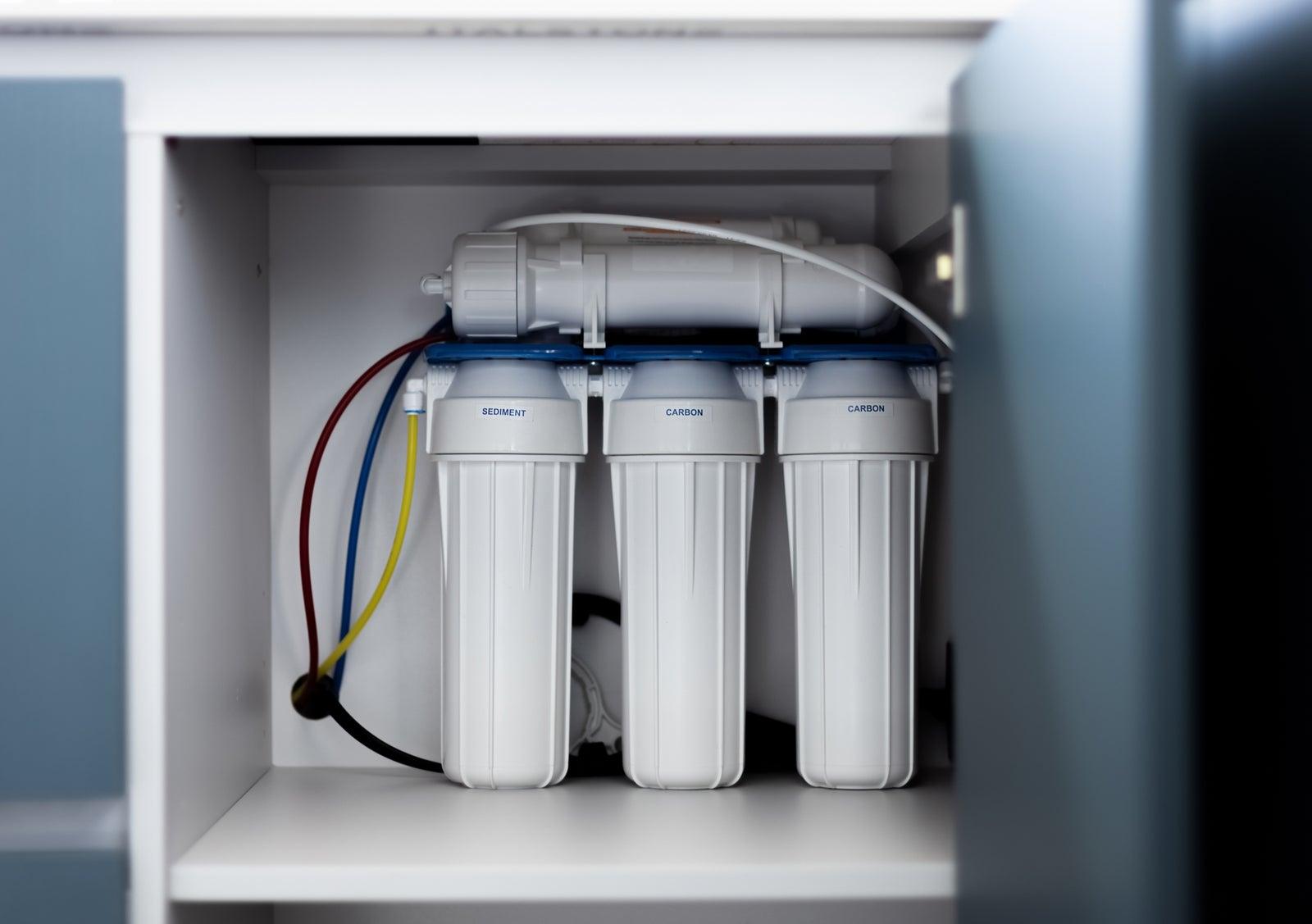
A home reverse osmosis system sends your tap water through several filters, with the RO membrane doing the heaviest work. Most home RO systems are point-of-use units that sit under the kitchen sink and supply a separate faucet for drinking and cooking water.
A typical system works in six stages:
Sediment pre-filter. Traps sand, rust, and silt that would otherwise clog the membrane.
Carbon pre-filter. Removes chlorine, which damages common thin-film membranes, and reduces tastes, odors, and some organic chemicals.
RO membrane. Water pressure pushes water through the membrane while dissolved contaminants are held back.
Storage tank. RO works slowly, so treated water collects in a small pressurized tank, typically 2 to 5 gallons, ready when you open the faucet.
Post-filter. A final carbon "polishing" filter removes any remaining taste or odor before the water reaches your glass.
Drain line. Rejected contaminants are flushed away through a connection to your sink drain.
Some systems add stages, such as a remineralization filter that adds minerals back for taste.
Permeate vs. Concentrate: Two Key Terms
Permeate is the treated water that passes through the membrane. It's the water you drink.
Concentrate, also called reject water or brine, is the water that carries the rejected contaminants down the drain.
Tank vs. Tankless Reverse Osmosis Systems
A tank system stores treated water so a full glass is ready the moment you need it. A tankless system filters on demand without a storage tank, which saves space under the sink. The better choice depends on how much cabinet space you have and how much filtered water your household uses.
What Does Reverse Osmosis Remove?
Reverse osmosis reduces a long list of dissolved contaminants, especially metals, salts, and nitrate. Here's what a household RO system can treat, based on guidance from the University of Nebraska–Lincoln Extension and the EPA.
Contaminant type | Examples | Reduced by RO? |
|---|---|---|
Heavy metals | Lead, arsenic, mercury, chromium, copper, cadmium | Yes |
Salts and dissolved solids | Sodium, chloride, sulfate, total dissolved solids (TDS) | Yes |
Nitrate and fluoride | Nitrate, fluoride | Yes |
Hardness minerals | Calcium, magnesium | Yes |
Radioactive elements | Radium, uranium | Yes |
Parasites | Protozoan cysts such as Cryptosporidium | Yes |
Certain pesticides | Lindane, endrin, heptachlor | Yes |
PFAS ("forever chemicals") | PFOA, PFOS | Potentially; check the system's certification |
Chlorine and many VOCs | Chlorine, trihalomethanes, solvents | Mostly by the system's carbon filters, not the membrane |
Total dissolved solids (TDS) is the combined amount of minerals, salts, and metals dissolved in water. RO is one of the few home treatment methods that lowers it significantly.
How much RO removes depends on the contaminant, how much of it is in your water, and the type and condition of the membrane. High starting levels matter. UNL gives an example: a membrane that removes 85% of nitrate would bring 80 mg/L down to 12 mg/L, which is still above the EPA's 10 mg/L limit.
To confirm a specific claim, look for a system certified to NSF/ANSI 58, the standard for reverse osmosis drinking water systems. Make sure the certification covers the contaminants you're actually worried about.
What Reverse Osmosis Doesn't Remove Well
Dissolved gases. Hydrogen sulfide, the cause of a rotten-egg smell, passes right through the membrane.
Some chemicals. Certain pesticides, solvents, and volatile organic chemicals (VOCs) get past the membrane. The carbon stages in an RO system handle many of these.
Bacteria in unsafe water. RO can remove microorganisms, but it isn't meant to disinfect water. UNL recommends feeding RO systems only water that's free of coliform bacteria.
Whole-house problems. An under-sink unit treats one faucet. It won't stop hard-water scale in your showers, water heater, or appliances.
What Is Reverse Osmosis Used For?
Reverse osmosis is used wherever very clean water matters, from kitchen sinks to hospitals. According to the U.S. Food and Drug Administration, RO has been known for more than a century but only became commercial in the early 1960s, once a special membrane was developed.
Today, common uses include:
Home drinking and cooking water, usually from an under-sink system.
Desalination, turning seawater and brackish water into drinking water.
Healthcare, including purified water for dialysis.
Pharmaceutical manufacturing, where water purity is tightly controlled.
Food processing, such as concentrating whey and other food products.
Industry, including boiler feed water and electronics manufacturing.
Is Reverse Osmosis Water Safe to Drink?
For most households, reverse osmosis water is safe to drink. It's often cleaner than untreated tap water because the system reduces contaminants like lead, arsenic, and nitrate.
Keep three things in mind:
Minerals. RO also lowers calcium and magnesium along with the contaminants. If you prefer the taste of mineral water, a remineralization stage can add minerals back after filtration.
pH. RO water can be slightly more acidic than tap water. Dissolved carbon dioxide passes through the membrane while the minerals that buffer pH are removed.
Maintenance. RO water stays clean only when the system does. UNL notes that maintaining the membrane and replacing filters on schedule are critical to performance and to limiting bacterial growth inside the system.
Reverse Osmosis vs. Water Filter: What's the Difference?
A reverse osmosis system is a type of water filter, but it treats a much wider range of contaminants than most basic filters. Many basic filters use carbon alone and mainly target chlorine taste and odor.
Option | Where it treats water | What it mainly addresses | Reduces dissolved salts and metals? |
|---|---|---|---|
Pitcher filter | One pitcher at a time | Chlorine taste and odor | Varies; some are certified for lead |
Faucet or fridge filter | One tap or dispenser | Chlorine taste and odor | Varies; some are certified for lead |
Whole-house filter | All water entering the home | Specific problems such as sediment, chlorine, or iron | Depends on the filter media |
Water softener | All water entering the home | Hardness (calcium and magnesium) | Hardness minerals only |
Reverse osmosis system | Usually one faucet | A broad range of dissolved contaminants | Yes |
If your concern is chlorine taste or sediment throughout the house, water filtration may be all you need. If testing shows dissolved contaminants in your drinking water, RO is the stronger choice.
Reverse Osmosis Pros and Cons
Reverse osmosis delivers some of the cleanest drinking water you can make at home, but it uses more water and upkeep than a basic filter.
Benefits of Reverse Osmosis
Reduces a broad range of contaminants, including lead, arsenic, nitrate, and fluoride.
Produces clear, clean-tasting water for drinking, cooking, coffee, and ice.
Cuts down on bottled water purchases.
Fits under the kitchen sink in most homes.
Pairs the membrane with carbon filters to cover chlorine and many organic chemicals.
What Are the Disadvantages of Reverse Osmosis?
Sends part of the incoming water down the drain.
Works slowly, so most systems need a storage tank.
Removes healthy minerals like calcium and magnesium along with contaminants.
Needs regular filter and membrane replacement.
Doesn't remove dissolved gases such as hydrogen sulfide.
Requires an upfront installation cost.
Does Reverse Osmosis Waste Water?
Yes. Every RO system sends some water to the drain to carry away the contaminants it rejects. According to the EPA, a typical point-of-use system sends 5 gallons or more down the drain for every gallon of treated water, and inefficient units can reach 10 gallons. UNL notes that most household systems are designed to turn only 20% to 30% of incoming water into treated water.
Efficient systems narrow that gap. RO systems that earn the EPA's WaterSense label can send no more than 2.3 gallons to the drain per gallon treated. EPA estimates that choosing one over a typical system saves more than 3,100 gallons a year on average. A shut-off valve that stops the flow when the storage tank is full also prevents needless waste.
If your home is on a septic system, keep in mind that RO wastewater adds to its load. EPA also points out that simpler filtration is sometimes enough, which is one more reason to test your water before you buy.
Do You Need a Reverse Osmosis System for Your Home?
You may benefit from reverse osmosis if testing shows contaminants that RO treats well, or if your tap water bothers you and basic filters haven't helped. Common signs include:
Cloudy or bad-tasting water, including a metallic or chemical taste.
Strong chlorine smell or other unpleasant odors.
Sediment, sand, or rust particles in your water.
Concerns about lead, pesticides, or chemicals in your drinking water.
Relying on bottled water because you don't trust your tap.
Basic filters that aren't working, with taste, odor, or clarity problems that don't improve.
Start With a Water Test
Before choosing any treatment, find out what's actually in your water. City water and well water call for different starting points:
City water: Your utility publishes an annual Consumer Confidence Report that lists the contaminants found in your supply. Remember that water can also pick up contaminants from pipes on the way to your tap.
Well water: Testing is your responsibility, so contamination is more likely to go unnoticed. Regular testing is the only way to know what you're drinking.
Not sure what's in your water? Horizon's water treatment specialists can test your water and recommend the right system. Call 800-642-4419.
Under-Sink vs. Whole-House Reverse Osmosis Systems
Most homes only need reverse osmosis at the kitchen sink. Whole-house reverse osmosis treats every faucet, but it's a much larger investment.
An under-sink system is a point-of-use (POU) system: it treats water only where it's used. It typically feeds its own faucet for drinking and cooking water.
A whole-house system is a point-of-entry (POE) system: it treats all the water as it enters the home. According to UNL, point-of-entry RO units cost more to buy, install, and operate than point-of-use systems.
Under-sink (point-of-use) | Whole-house (point-of-entry) | |
|---|---|---|
What it treats | Drinking and cooking water at one faucet | Every faucet, shower, and appliance |
Cost to buy, install, and run | Lower | Higher |
Water sent to the drain | Less | More, since all household water is treated |
Space needed | Fits in a sink cabinet | Needs room near the main water line |
Best fit | Most homes with drinking-water concerns | Homes with serious water quality problems throughout the house |
Many homeowners get the best of both by combining whole-house treatment, such as filtration or softening, with an under-sink RO system for drinking water.
Reverse Osmosis Maintenance: Filter and Membrane Schedule
Reverse osmosis maintenance comes down to changing filters every 6 to 12 months and the membrane every 2 to 5 years. Your actual schedule depends on your water quality and how much water you use.
Part | Typical replacement | Why it matters |
|---|---|---|
Sediment and carbon pre-filters | Every 6 to 12 months | Protect the membrane from silt and chlorine |
Carbon post-filter | Every 6 to 12 months | Keeps water tasting and smelling clean |
RO membrane | Every 2 to 5 years | Wears and clogs over time, which lowers performance |
System sanitizing | As the manufacturer directs | Limits bacterial growth inside the system |
For comparison, EPA WaterSense-labeled systems must use a membrane rated to last at least one year before replacement.
Signs Your RO System Needs Service
Water flows slowly, or the tank takes longer to refill.
Bad taste or odor returns.
A TDS monitor or filter light signals a problem.
Water runs to the drain constantly, even when the tank is full.
You see leaks or moisture under the sink.
The filters are past their replacement date.
A damaged membrane isn't always easy to spot, so test your treated water periodically to make sure the system is still doing its job.
Can You Install a Reverse Osmosis Water Filtration System Yourself?
Handy homeowners can install some under-sink kits, but professional installation avoids the most common problems. A typical installation includes:
Tapping into the cold-water line.
Drilling the sink or countertop for a dedicated faucet.
Connecting the drain line.
Placing and pressurizing the storage tank.
Checking water pressure, and adding a booster pump if it's too low.
RO-treated water can be more corrosive than untreated water, so the plumbing installed with the system needs to handle it. A loose fitting under the sink can also cause water damage that goes unnoticed for weeks.
A licensed plumber tests your water first, recommends a system that fits your results, and confirms the system works before leaving. Learn more about Horizon's reverse osmosis system installation and sink and faucet services.
Why Choose Horizon for Reverse Osmosis
Help is on the way! Horizon's water treatment specialists install, repair, and replace reverse osmosis systems throughout Delaware, Southeastern Pennsylvania, South Jersey, and parts of Maryland.
We prefer a six-stage alkaline reverse osmosis system with an Ayer's Rock alkaline filter. It's built from:
A five-micron sediment pre-filter
A five-micron carbon block filter
A five-micron granular activated carbon block filter
A 75-gallon-per-day reverse osmosis membrane
An Ayer's Rock alkaline filter
A one-micron post-carbon polishing filter
When you call Horizon, you get:
Same-day service and next-day installation
Upfront pricing before plumbing work begins
Licensed, experienced plumbers
A water test before we recommend a system
A satisfaction guarantee
Our Comfort360 membership includes 15% off all plumbing services and waived diagnostic fees with repairs. Find your local team on our service areas page, or call 800-642-4419.
We serve homeowners in Wilmington, Newark and Dover, Delaware; Philadelphia, West Chester and King of Prussia, Pennsylvania; Cherry Hill Township and Camden, New Jersey; and Baltimore and Elkton, Maryland, plus surrounding communities.
Reverse Osmosis FAQs
Is reverse osmosis water better than distilled water?
Both produce very clean water, and neither is better for every home. Distillation boils water and collects the steam, which leaves contaminants like heavy metals behind. However, NSF notes that some volatile organic chemicals can carry over with the vapor. RO uses pressure and a membrane, usually paired with carbon filters that handle many of those chemicals, and it delivers water straight from a faucet.
Does reverse osmosis remove fluoride?
Yes. Fluoride is one of the contaminants household RO systems treat effectively, according to the University of Nebraska–Lincoln Extension. How much is removed depends on the starting level and the condition of the membrane.
Does reverse osmosis remove PFAS?
Reverse osmosis can potentially remove PFAS, according to the EPA. Results vary by system, so choose one that's certified to reduce the specific PFAS you're concerned about, such as PFOA or PFOS.
Does reverse osmosis remove bacteria and viruses?
RO can remove microorganisms, but it isn't designed to disinfect water. UNL recommends feeding RO systems only water that's free of coliform bacteria. Bacteria can damage the membrane and slip through tiny leaks. If testing finds bacteria in your water, treat that problem first.
Can you use reverse osmosis with well water?
Yes. Many well owners use RO for drinking water. Test your well first, since monitoring a private well is the owner's responsibility. Cold well water also slows production: UNL estimates 45°F water produces about half as much treated water as 77°F water. Low well pressure may require a booster pump. Learn more about our well pump services.
Can you have a reverse osmosis system and a water softener?
Yes. They do different jobs and work well together. A water softener reduces hardness minerals throughout your home, while an RO system treats drinking water at one faucet. Softening hard water before it reaches the RO system can also extend the membrane's life.
Related Articles
What do you need help with today?
Heating
No heat, strange smells, rising bills? We repair and replace heating systems to keep your home reliably warm.
Air Conditioning
AC blowing warm air? Uneven cooling in your rooms? We fix cooling issues fast and keep your system running smoothly all summer.
Plumbing
Our highly trained plumbers handle it all, from leaky faucets to full system installations and repipes.
Electrical
The smartest team in town. You need repair, installations, wiring, inspections, lighting — you name it.