
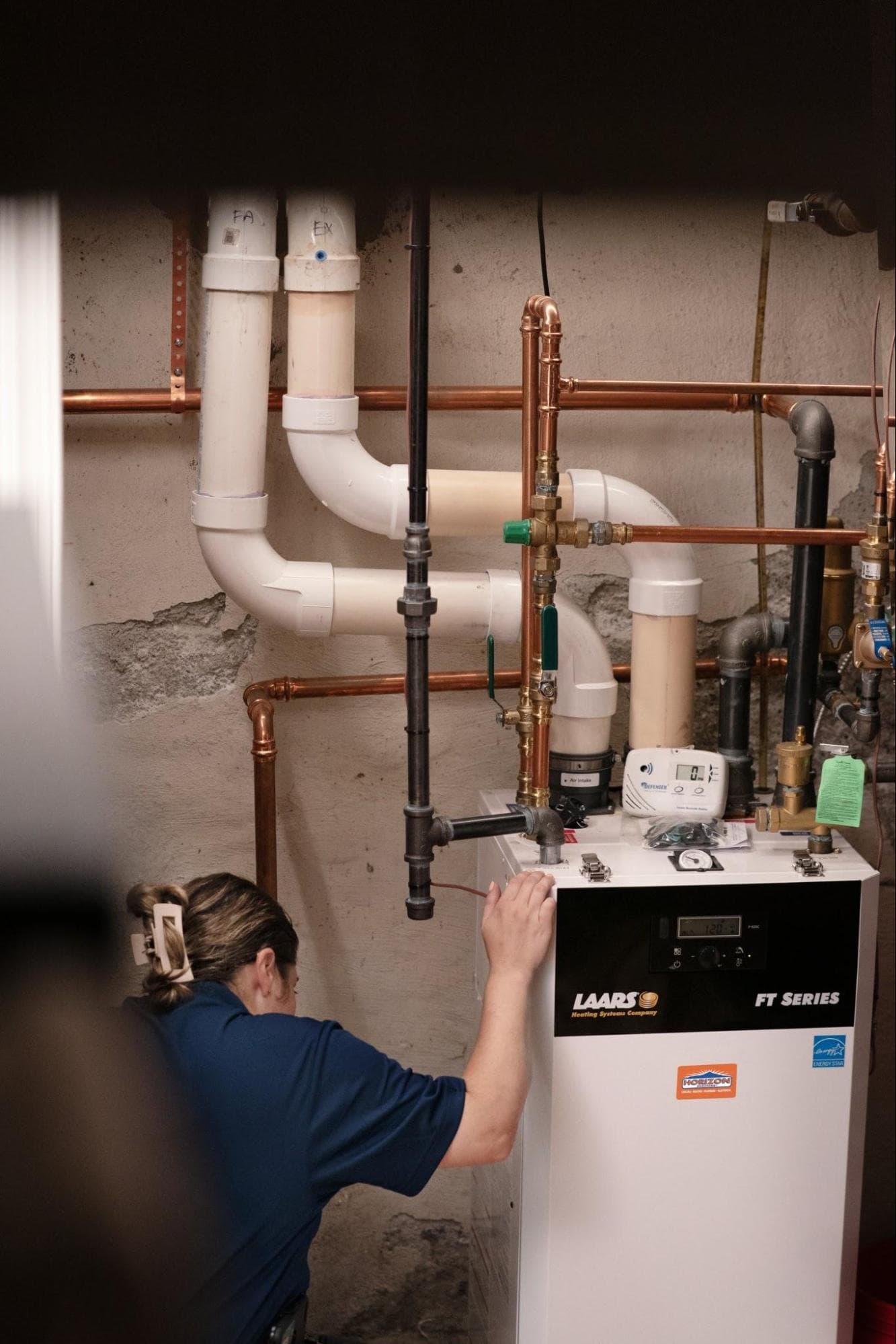
A boiler that fires while the radiators stay cold is making heat it cannot move, and the cause is almost always trapped air, low system pressure, a failed circulator pump, a stuck zone valve, a diverting valve stuck on the hot water side, sludge in the return, an unbalanced system or a control fault. Bleed one upstairs radiator first. That single step resolves or eliminates the most common cause in about ten minutes.
On this page:
What to check first
8 reasons the radiators stay cold
Symptom, likely cause, what to do
Bleeding, pressure and balancing
Steam systems: banging, venting and pitch
Repair, replace, or change the system
FAQs
The burner lighting tells you almost nothing about whether heat is reaching the house. A boiler has two jobs: make hot water, and move it. Most cold-radiator calls in older Delaware Valley homes are failures of the second job, not the first.
That is good news for the homeowner standing in a cold living room. Circulators, zone valves, air vents and controls are individually replaceable parts, and a boiler with a sound heat exchanger can run another decade after one of them is swapped.
What to Check First
Four checks, in this order. Each one eliminates a branch of the list below.
Confirm the thermostat is actually calling for heat. Set it well above room temperature and listen. If the boiler was already running for domestic hot water, you may have been watching the wrong cycle entirely.
Read the pressure gauge on the boiler. Most residential hot water systems sit around 12 to 15 psi cold, and the correct figure for your system is printed on the data plate. A gauge reading near zero explains everything else.
Put a hand near the supply pipe leaving the boiler. Hot supply and cold returns means water is not circulating. Both pipes cold means the boiler is not heating the loop at all.
Bleed one upstairs radiator. If water comes out clean and the radiator warms, you have found it. If only air comes out and nothing changes, the problem is flow.
If you smell gas at any point, stop. Leave the house, call 911 or your gas utility from outside, and do not go back in until they clear it.
8 Reasons the Radiators Stay Cold
These are ordered roughly by how likely you are to be able to resolve them yourself, so the useful ones are at the top.
Air Trapped in the Radiators
Air rises and collects at the highest points in the system, which is why the second floor goes cold first and why the top of a radiator can be cold while the bottom is hot. Bleeding is the fix and it is a homeowner job.
Low System Pressure
A hot water system that has lost pressure cannot push water to the upper floors. The gauge tells you immediately. Topping up restores heat, but a system that needs it more than very occasionally is losing water somewhere and that leak needs finding.
A Failed Circulator Pump
The circulator is the part that actually moves heated water through the loop. When it fails, the boiler happily makes hot water that never leaves the basement. A seized or silent circulator with a hot boiler is the classic version of this symptom.
A Stuck Zone Valve
In a zoned system, each zone has a valve that opens when that thermostat calls. A valve stuck closed leaves one whole floor or wing cold while the rest of the house heats normally. That selective pattern is the giveaway.
A Diverting Valve Stuck on the Domestic Hot Water Side
If your showers are fine and your radiators are not, the burner is clearly working. On combination systems the diverting valve decides whether heated water goes to the taps or to the heating loop, and one stuck on the domestic side produces exactly this split.
Sludge in the Return Piping
Decades of corrosion products settle in the lowest and slowest parts of an old system. Heavy sludge restricts flow through the radiators it reaches last, which usually means the far end of a long run or the top of the house.
An Unbalanced System
Water takes the easiest path. Without balancing, the radiators closest to the boiler take most of the flow and the distant ones get what is left. This one is rarely sudden, so if the house has always heated unevenly, balancing is the likely answer.
A Control or Thermostat Fault
An aquastat holding the boiler on domestic hot water priority, a failed relay, a bad zone thermostat or a wiring fault all produce a boiler that fires without ever energizing the circulator. These need a technician with a meter.
Symptom, Likely Cause, What to Do
Find the row that matches what you are seeing. The right-hand column tells you honestly whether it is yours to fix.
Symptom | Likely cause | What to do |
Second floor radiators never get hot | Air trapped at the high points, or unbalanced flow | Bleed the upstairs radiators first, then call if they stay cold |
All radiators cold while the boiler fires | Failed circulator, stuck zone valve or a control fault | Call. The boiler is making heat it cannot move |
Hot water works, heat does not | Diverting valve, zone valve or circulator on the heating side | Call. The domestic side working proves the burner is fine |
Radiator hot at the bottom, cold at the top | Air in that radiator | Bleed the radiator |
Banging pipes when the boiler starts | Pipe expansion against a hanger, or trapped air | Bleeding often solves it. Persistent banging needs the pipe supports looked at |
Steam boiler banging loudly at night | Condensate trapped in a pipe or radiator that has lost its pitch | Call. Water hammer in steam damages pipe and is fixable |
Low water cutoff keeps shutting the boiler down | A real water loss, or a fouled probe or float | Call. Never bypass the cutoff. It is a safety device |
Pressure dropping repeatedly | A leak in the system, or a failing expansion tank | Call. Topping up a system that keeps losing water hides the leak |
If your row says call, Horizon services hot water and steam boilers across Delaware, southeastern Pennsylvania, South Jersey and parts of Maryland. Schedule boiler repair or call 1-800-642-4419.
Bleeding, Pressure and Balancing
Bleeding is the one real homeowner fix on the list, and doing it in the right order matters.
Work from the lowest radiator in the house to the highest. Open each vent with the key or a screwdriver, let the air hiss out, and close it the moment water appears. Have a cup and a rag ready, because the water will be dirty.
If every radiator bleeds clean and the upstairs still runs cold, you have learned something valuable: the problem is flow, not air. That points at the circulator, a zone valve, sludge or balancing, and it is a technician's call from there.
Checking and Topping Up Boiler Pressure
Find the pressure gauge on the boiler and compare it against the figure on the data plate. Typical residential hot water systems read around 12 to 15 psi cold.
If it has dropped, the fill valve adds water slowly until the gauge reads correctly. Go slowly, watch the gauge, and never walk away with the fill valve open.
Here is the part that matters more than the procedure. A system needing regular top-ups has a leak, and every refill introduces fresh oxygenated water that corrodes the boiler and the piping from the inside. Find the leak rather than feeding it. Our guide to why a boiler leaks water covers where to look.
Why the Low Water Cutoff Keeps Tripping
The low water cutoff stops the boiler firing when there is not enough water in it, which is the failure that destroys boilers and can be dangerous.
Repeated trips mean one of two things: the system is genuinely losing water, or the probe or float has fouled. Both need a technician. The cutoff must never be jumpered, bypassed or disabled to keep the heat on overnight.
Steam Systems: Banging, Venting and Pitch
Steam is a different animal, and a lot of contractors in this region will not touch it. Horizon will, so it is worth explaining what the noise actually is.
The bang is condensate being picked up and thrown by incoming steam. It happens where water is sitting in a pipe or radiator instead of draining back toward the boiler, and the impact is genuinely hard enough to damage fittings over time.
The causes are specific and the fixes are concrete. A radiator that has lost its pitch gets re-pitched on its feet. Sagging pipe runs get their supports corrected. Failed vents and traps get replaced. An overfilled boiler gets brought back to its normal water line.
None of that is exotic work. Water hammer is not something you live with in an old house, and a properly vented, properly pitched steam system is quiet, comfortable and very long-lived.
Cast Iron Radiator Upkeep
Cast iron radiators are close to indestructible and ask for very little. Keep the air vents clear and working, bleed annually, exercise the shutoff valves so they do not seize, and do not paint over a vent.
Skip the decorative covers that box a radiator in and trap its output. In older Maryland and Pennsylvania farmhouses the radiators routinely outlive several boilers, which is a good argument for keeping them when the boiler gets replaced.
Repair, Replace, or Change the System
Once the immediate problem is diagnosed, the longer question usually follows.
Repair a 25-Year-Old Boiler or Budget for New
Repair it if the failure is a pump, a control, a valve or a vent and the heat exchanger is sound. Boilers regularly run 25 to 30 years, so age by itself is not the trigger.
Start budgeting when the heat exchanger is cracked or seeping, when sections are weeping at the joints, when parts have to be hunted down, or when a second significant repair lands in the same season. Horizon quotes boiler replacement free, so you can put a real number against the repair before deciding.
Adding Outdoor Reset on a Replacement
Worth it. Outdoor reset varies the water temperature with the outdoor temperature, so the boiler produces 140-degree water on a mild day instead of 180. That cuts short cycling and fuel use and makes the heat feel steadier.
On a condensing boiler it is not optional in practice, because lower return water temperatures are what let the unit condense and deliver its rated efficiency.
Keeping Steam or Converting to Hot Water
Keeping steam is usually the better value. Conversion means new piping throughout, new or converted emitters, and serious disruption, while a well-maintained steam system with correct venting and pitch is comfortable and lasts.
Convert when the distribution piping is failing anyway, when you are gutting the house, or when you want zoning that steam cannot easily provide.
Switching from a Boiler to Forced Air
This is a whole-house project rather than an equipment swap, because there are no ducts to reuse. Expect duct routing through closets, soffits or the attic, returns in every major space, chases cut between floors, and the radiators removed.
It does bring central air conditioning with it, which is usually the real motivation. Where ductwork would be destructive, ductless heads or an air-to-water heat pump get you there with less demolition.
Air-to-Water Heat Pumps
An air-to-water heat pump can replace a boiler today, with two conditions. The emitters have to work at lower water temperatures, and the electrical service has to carry the load.
Oversized old cast iron radiators are often a surprisingly good match, because they were sized generously to begin with and give up heat well at temperatures that would leave a modern baseboard cold.
Swap Downtime and Permits
Plan on the heat being off for the working day on a like-for-like replacement, and one to two days where the piping, the venting or the chimney liner also change.
Permits for boiler replacement are set by your township or city rather than at the state level, and most jurisdictions across Pennsylvania, Delaware, New Jersey and Maryland require a permit and an inspection. Horizon pulls the permit and schedules the inspection as part of the job.
Winterizing Before a Long Trip
Do not shut the system off. Leave it running at a reduced setpoint, around 55 degrees, so the pipes stay above freezing.
Before you go, confirm the low water cutoff and the pressure gauge read normally, leave interior doors open so heat circulates, and arrange for someone to check the house during an extended cold snap. Draining a wet system is a last resort and is not a homeowner job.
What You Can Do and When to Call
The split here is unusually clean for heating equipment.
Handle these yourself:
Bleeding radiators, lowest to highest
Reading the pressure gauge against the data plate
Topping up pressure slowly with the fill valve, watching the gauge
Keeping radiator vents clear and unpainted
Exercising shutoff valves once a season so they do not seize
Call a technician for these:
A circulator pump that is silent, seized or leaking
Zone valves, diverting valves and aquastats
Anything involving the low water cutoff, which must never be bypassed
Steam re-pitching, trap and vent replacement
Any leak, and any system that loses pressure repeatedly
System flushing for sludge, and balancing
Why Choose Horizon Services for Boiler and Radiator Work
Most contractors in this region quietly avoid hydronics. Horizon does not, and that is the practical difference when your heat is water rather than air.
Our technicians work on hot water and steam systems, and our installed lines include Weil-McLain, Laars, Crown Boiler and Boyertown. You can see the full list on our preferred brands page.
We cover Delaware, southeastern Pennsylvania, South Jersey and parts of Maryland, with free estimates on replacement and emergency heating service when the house is cold and it cannot wait.
Call 1-800-642-4419 to schedule.
Boiler Running but Radiators Cold FAQs
My radiators stay cold even though the boiler fires up.
The boiler is making heat it cannot move, which points at the circulator pump, a stuck zone valve or a control fault rather than the burner. Bleed one radiator first to rule out trapped air. If every radiator stays cold after bleeding, it is a pump or valve problem and needs a technician.
My second floor radiators never get hot, what's wrong?
Air rises and collects at the highest points, so upstairs radiators go cold first. Bleed each one until water appears, working from the lowest radiator in the house to the highest. If they stay cold after bleeding, the cause is flow rather than air: unbalanced circuits, a weak circulator, a stuck valve or sludge.
My boiler heats water fine but the heat side won't work.
Working showers prove the burner and the heat exchanger are fine, which moves the whole problem to the heating loop. On a combination system, suspect a diverting valve stuck on the domestic side. On a zoned system, suspect a zone valve or the circulator serving the heating zones.
How do I check my boiler pressure and top it up safely?
Read the gauge on the boiler. Most residential hot water systems sit around 12 to 15 psi cold, and your exact figure is on the data plate. Open the fill valve slowly until the gauge reads correctly, and never leave it open unattended. Frequent topping up means a leak worth finding.
Steam boiler banging loudly at night, how do I stop water hammer?
Water hammer is condensate being thrown by incoming steam, which means water is trapped where it should be draining back. The usual causes are a radiator or pipe run that has lost its pitch, a failed steam trap or vent, or an overfilled boiler. All are fixable and none should be tolerated.
Low water cutoff keeps shutting my boiler down.
The cutoff is doing its job: it stops the boiler firing without enough water, which is the failure that destroys boilers. Repeated trips mean the system is genuinely losing water or the probe or float has fouled. Both need a technician, and the cutoff must never be jumpered or bypassed.
Worth repairing a 25 year old boiler or time to budget for new?
Repair it if the failure is a pump, control, valve or vent and the heat exchanger is sound, since boilers routinely run 25 to 30 years. Start budgeting when the heat exchanger is cracked or seeping, when parts must be hunted down, or when a second significant repair arrives in the same season.
Related Articles
What do you need help with today?
Heating
No heat, strange smells, rising bills? We repair and replace heating systems to keep your home reliably warm.
Air Conditioning
AC blowing warm air? Uneven cooling in your rooms? We fix cooling issues fast and keep your system running smoothly all summer.
Plumbing
Our highly trained plumbers handle it all, from leaky faucets to full system installations and repipes.
Electrical
The smartest team in town. You need repair, installations, wiring, inspections, lighting — you name it.