
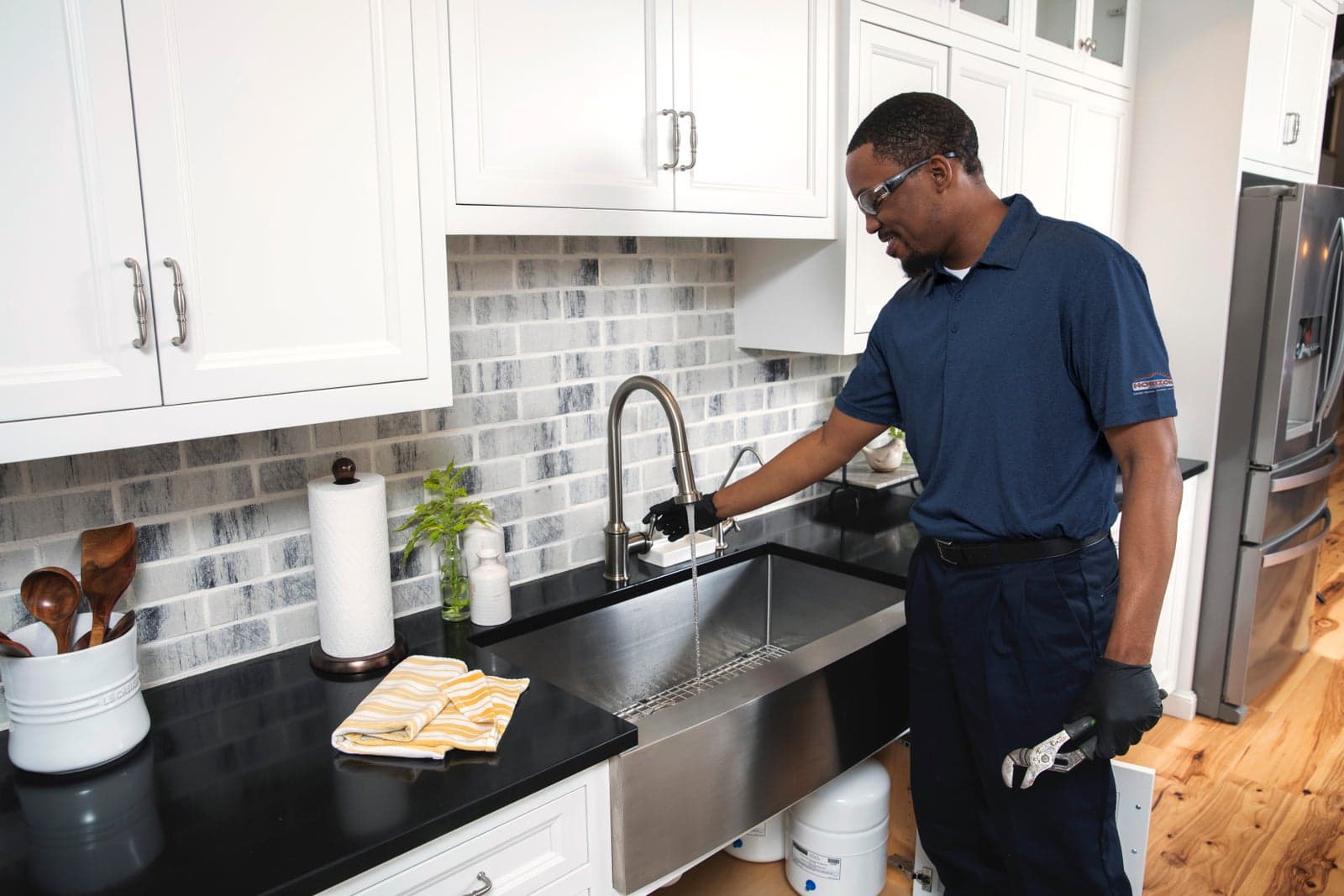
Most plumbing problems sort into three buckets. Parts you can swap with the water off, like a toilet flapper or a faucet aerator, are worth doing yourself. Anything that touches an old shutoff valve, a toilet flange, whole-house pressure or polybutylene piping belongs to a plumber. And anything where water is escaping and you cannot stop it at the fixture means shutting the main off first, then calling.
On this page:
Finding your main shutoff
The 14 problems, sorted
What you can fix yourself
What needs a plumber
What means call right now
Before you list the house, and home warranties
FAQs
The honest answer to “should I fix this myself” is that it depends on one thing more than skill: whether the failure is a part or a system.
A flapper is a part. A toilet that rocks is a system, because the thing under it has moved. A dripping aerator is a part. A shower that goes scalding when someone flushes is a system, because the pressure in the house changed and the valve could not hold the mix.
Parts are cheap, reversible and forgiving. Systems are none of those things, and the moment you open one up, the old components around it start failing too. That is the line this list draws.
Before Anything Else: Find Your Main Shutoff
Every item below assumes you can stop the water. Most homeowners find out they cannot on the worst possible night.
In our service area the main shutoff is usually in one of three places: on the street-facing basement wall near the water meter, at the point where the service line enters a crawlspace, or in a utility closet, garage wall or exterior box if you are in a slab home.
Find it today and turn it, all the way closed and all the way back open, while nothing is flooding.
Here is why that matters. Old gate valves seize in place. A valve that has not moved in twenty years is the valve that snaps in your hand during an emergency, and a broken main in the middle of a flood is a far worse day than a scheduled valve replacement. If yours fights you, have it swapped for a quarter-turn ball valve while the house is dry.
The 14 Problems, Sorted
This is the whole article in one table. The detail on each item follows below.
Problem | Verdict | What to do |
Toilet runs every few minutes all night | Fix it yourself | Replace the flapper, then the fill valve if it continues |
Faucet flow has gone weak at one tap | Fix it yourself | Unscrew and clean the aerator |
Garbage disposal hums or does nothing | Fix it yourself | Press the reset underneath, free the impeller with the hex key |
One sink drains slowly | Fix it yourself | Clean the stopper and trap, then hand-snake that line only |
Tub drains slowly | Fix it yourself | Pull and clear the stopper linkage |
Showerhead is scaled or spraying sideways | Fix it yourself | Swap it, and use thread tape rather than force |
Compression nut weeping under a sink | Fix it yourself, once | A quarter turn, no more. Still weeping means call |
Bathroom faucet needs replacing, stops are old | Call a plumber | The supply stop usually fails during the swap |
Toilet rocks when you sit down | Call a plumber | Flange or subfloor, not the toilet |
Fill valve hisses for hours after a flush | Call a plumber | Flush valve seat or supply pressure if new parts did not fix it |
Pipes bang when the washing machine stops | Call a plumber | Arrestors and a pressure check, not a pipe strap |
Shower goes scalding when a toilet flushes | Call a plumber | Pressure-balance cartridge or a missing mixing valve |
Polybutylene supply piping | Call a plumber | Assess the system, do not chase one leak |
Disposal tripped the reset and stayed dead | Call a plumber | Motor or circuit, not a jam |
Water through a ceiling light fixture | Call right now | Breaker first, then the main, then stay clear |
Main shutoff snapped in your hand | Call right now | Shut the water heater off and call for emergency service |
What You Can Fix Yourself
These seven are genuinely worth an hour of your Saturday. Each one ends with the condition that turns it into a call.
Running Toilet
A toilet that refills every few minutes is almost always a flapper that has gone soft and stopped sealing, or a fill valve that no longer shuts off cleanly. Both are inexpensive parts, both come out with the supply closed and the tank emptied, and neither requires a tool you do not own. If a new flapper and a new fill valve both fail to stop it, stop there and call.
Weak Faucet Flow
When one tap slows down and the rest of the house is fine, the aerator at the tip has caught scale and grit. Unscrew it, rinse the screen, soak it in white vinegar if it is crusted, and reassemble. Weak flow at every fixture is a different problem entirely and points at house pressure.
Jammed Garbage Disposal
A disposal that hums is jammed, not dead. Cut the power at the switch, use the hex key in the socket underneath to rock the impeller free, then press the red reset button on the bottom of the unit. If it runs again, you are done. See garbage disposal repair if it does not.
One Slow Sink Drain
A single slow fixture with every other drain running normally is a local clog. Pull the stopper, clean what is wrapped around it, and pull the trap if you are comfortable with a bucket underneath. Multiple slow drains at once is a main line issue and a different call.
Slow Tub
Tub stoppers collect hair at the linkage rather than in the pipe. Lift the lever, withdraw the plunger or pop-up assembly, clean it and put it back.
Old Showerhead
Scaled or crooked showerheads unscrew by hand more often than people expect. Wrap the threads in tape, hand-tighten the new one, and do not put a wrench on a brass arm that is set into tile.
A Weeping Compression Nut
A visible compression nut under a sink that has begun to seep will often stop with a quarter turn. One quarter turn. Past that you are stretching the ferrule, and a nut that keeps weeping after a gentle snug is telling you the joint has to come apart.
If you want a short list of what to keep on hand for all of the above, our five plumbing tools worth owning covers it.
What Needs a Plumber
These seven share a pattern. In each one, the visible symptom is downstream of the actual failure.
Bathroom Faucet Replacement With Old Supply Stops
Swapping the faucet is the easy half. The hard half is that a twenty-year-old supply stop frequently fails the moment it is asked to close, and you find that out with the old faucet already off and the new one still in the box. A plumber replaces the stops as part of the job. Details on faucet and sink repair.
A Toilet That Rocks
The toilet is fine. The flange it sits on, or the subfloor holding that flange, has moved. Shimming it hides the problem and keeps the wax seal broken, which puts water under the floor every flush. If you want the mechanics, how a toilet actually works explains what the flange is doing.
A Fill Valve That Hisses for Hours
A new flapper and a new fill valve should end this. When it continues, the next suspects are a pitted flush valve seat or supply pressure sitting higher than the valve is designed for, and both need gauges rather than parts.
Water Hammer
The bang you hear when the washing machine shuts its valve is a column of moving water stopping instantly. Strapping the pipe quiets the noise and leaves the shock in the system. The real fix is properly placed arrestors plus a pressure check, because high static pressure makes hammer worse and shortens the life of every appliance valve in the house. Our post on diagnosing plumbing noises goes deeper.
A Shower That Goes Scalding on a Flush
The toilet takes cold water from the same branch feeding your shower, the mix shifts hot, and you jump. The fix is a pressure-balancing or thermostatic shower valve that holds the blend when supply pressure moves. In older homes with undersized branch lines, a thermostatic mixing valve at the water heater helps as well.
Polybutylene Supply Piping
Individual fittings can be repaired. The material itself degrades from the inside, which means a repair is a patch on a system with a known failure mode rather than a fix. Most plumbers will stop the active leak and then recommend assessing the whole run. Read what polybutylene pipes are and whether they need replacing, and see whole-home repiping for what the work involves.
A Disposal That Stayed Dead After the Reset
If the hex key turned freely and the reset button did nothing, the jam was never the problem. You are looking at a failed motor, a bad switch or a circuit issue, and none of those are fixed from under the sink.
What Means Call Right Now
These are not judgment calls. Stop reading and act.
Water coming through a ceiling light fixture. Kill the breaker for that light first, then shut the main. Water in a fixture has already crossed live wiring.
A sagging ceiling holding water. Stay out from under it. The trapped weight is far greater than it looks and it comes down all at once.
The main shutoff snapped in your hand. Shut the water heater off so it does not fire on an empty tank, and call for emergency service.
A toilet overflowing with a stop that will not turn. Lift the flapper closed by hand inside the tank to stop the flow while you get to the main.
No water anywhere in the house. Especially in winter, this is a frozen or broken service line and it does not improve on its own.
Sewage backing up into more than one fixture. Stop using every drain in the house. Each flush adds to what is already on the floor.
Horizon answers 24/7 emergency plumbing service calls across Delaware, southeastern Pennsylvania, South Jersey and parts of Maryland. Call 1-800-642-4419.
Before You List the House, and Home Warranties
Two questions come up constantly and neither one is really about plumbing skill.
What to Fix Before You Sell
The items that land on inspection reports in this market are the same ones every time: polybutylene supply lines, active drips under vanities, corroded shutoff valves, a water heater past its service life with no expansion tank or pan, toilets that rock, and older drain lines in homes built before 1980.
The drain lines are the one worth getting ahead of. A camera should see that pipe before a buyer's inspector does, because you want to be the person deciding what happens next rather than the person responding to a report.
Small active leaks belong on the list too. Why a small leak should not wait covers what a slow drip does to a cabinet floor, and leak detection covers the ones you cannot see.
What a Home Warranty Actually Covers
A home warranty is a service contract, not insurance. That distinction decides everything, because coverage turns on the specific exclusions written into your contract rather than on the type of failure you had.
Three clauses reduce or deny most plumbing claims: pre-existing conditions, code upgrade exclusions, and access exclusions covering work behind walls or under slabs. Read those three sections before you file anything.
Then ask the administrator one question in advance: may you choose your own contractor? The answer shapes how the whole claim goes.
Why Choose Horizon Services for Plumbing Repair
Horizon has served Delaware, southeastern Pennsylvania, South Jersey and parts of Maryland for decades, and the housing stock here is the reason our technicians know what a 1950s cast iron stack and a 1980s polybutylene run look like before they open the wall.
We answer the phone 24 hours a day, seven days a week, including nights, weekends and holidays.
See plumbing repair for what we handle, or read why homeowners choose Horizon. To schedule, call 1-800-642-4419.
Fix It Yourself or Call a Plumber FAQs
Should I fix a running toilet myself or call a plumber?
Start it yourself. A toilet that runs every few minutes is usually a worn flapper or a fill valve that has stopped sealing, and both are inexpensive parts you can change with the water off. Call a plumber if a new flapper and fill valve do not stop it, because the next suspects are the flush valve seat or supply pressure.
Where is my main water shut off valve in an old house?
In most older homes here it sits on the street-facing basement wall near the water meter, where the service line enters the house. In slab homes it is often in a utility closet, a garage wall or an exterior box near the curb. Find it and turn it once now, before an emergency forces the issue.
There's a slow drip under my bathroom sink. Can I wait until payday?
Only if you contain it and check it daily. A slow drip soaks particleboard, and the cabinet floor and the wall behind it fail long before the leak looks serious. Put a pan under it, dry the cabinet completely, and watch for swelling. Any musty smell means it has already been wet a while.
Can a plumber fix polybutylene piping or does it all need replacing?
Individual polybutylene fittings can be repaired, but the material degrades from the inside, so a repair is a patch on a system with a known failure mode. Most plumbers will stop the active leak and then recommend repiping rather than chasing the next one. It is also a recurring item on inspection reports at resale.
Why does my shower go scalding hot when someone flushes the toilet?
The toilet pulls cold water from the shower's mixed supply, so the blend shifts hot. The fix is a pressure-balancing or thermostatic shower valve, which holds the mix when supply pressure changes. A whole-house thermostatic mixing valve at the water heater helps too, particularly in older homes with undersized branch lines.
Water is pouring through my ceiling light fixture. What do I do?
Shut off the breaker for that light first, then shut the water off at the main. Water in a light fixture means it has already crossed live wiring. Stay out from under a sagging ceiling, because the trapped weight is far greater than it looks, and call for emergency plumbing service before anyone tries to drain it.
Related Articles
What do you need help with today?
Heating
No heat, strange smells, rising bills? We repair and replace heating systems to keep your home reliably warm.
Air Conditioning
AC blowing warm air? Uneven cooling in your rooms? We fix cooling issues fast and keep your system running smoothly all summer.
Plumbing
Our highly trained plumbers handle it all, from leaky faucets to full system installations and repipes.
Electrical
The smartest team in town. You need repair, installations, wiring, inspections, lighting — you name it.