
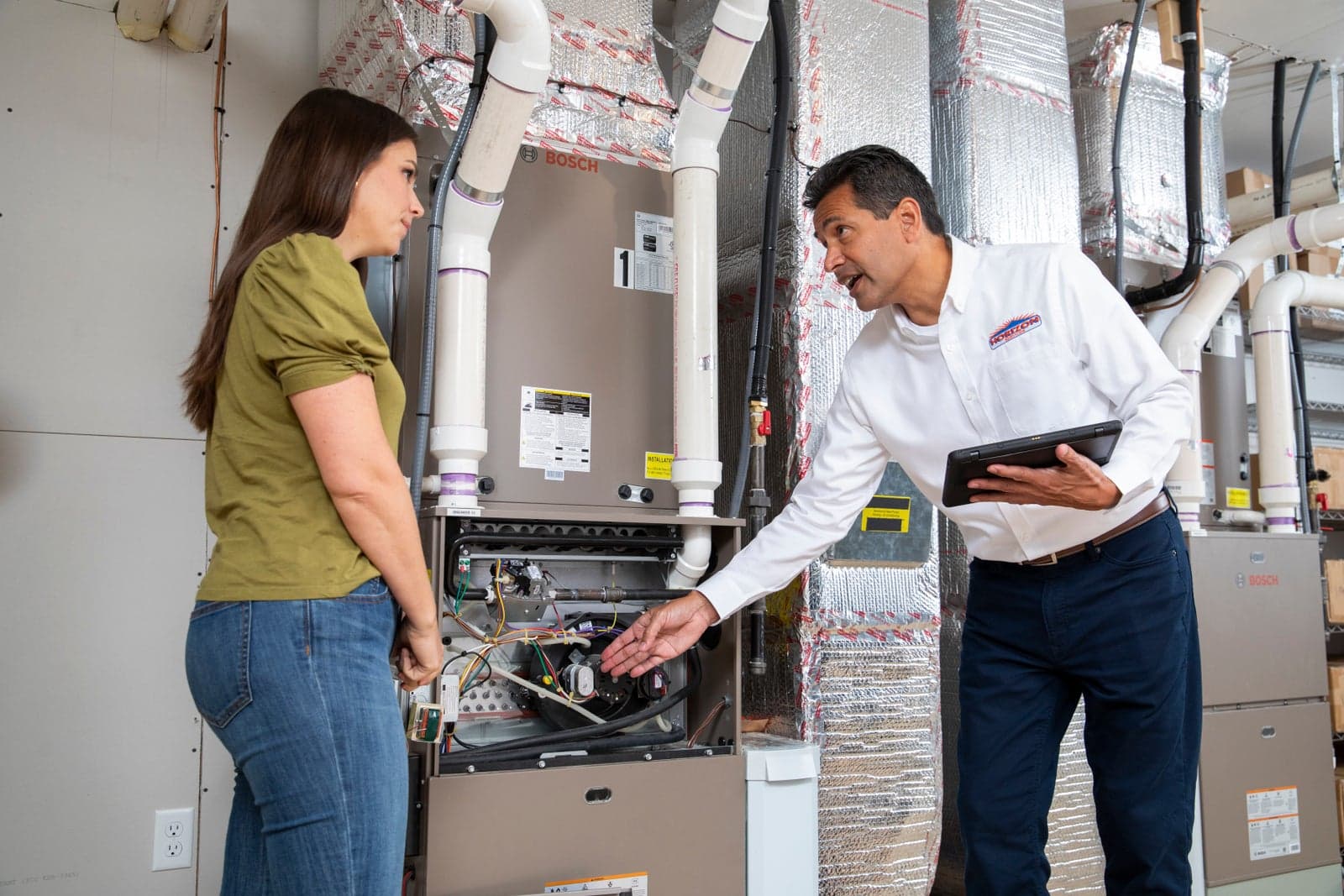
For most homes in Delaware, southeastern Pennsylvania and South Jersey, a modern heat pump is the better choice, because our winters are mild with short hard snaps rather than cold as a baseline. A gas furnace still wins where gas service already exists and the furnace has life left, where the electrical service cannot support a conversion, or where the house has no ductwork at all. Dual fuel covers the middle.
On this page:
What a Delaware Valley winter asks of a system
Why a heat pump usually wins here
When a furnace or boiler is the right call
Dual fuel and the coldest nights
Which system for which house
Comparing quotes, and what rebates are left
FAQs
Every comparison article you can find on this question was written for the whole country at once. That is the problem with all of them.
The right answer here depends on two things that are purely local: how cold it actually gets on the worst night of a normal winter, and what is already in your basement. A house in Wilmington with gas at the street and a twelve-year-old furnace is a completely different decision from a Philadelphia row home on radiators, and both are different from a house in Kent County still burning oil.
So start with the temperature, because everything else follows from it.
What a Delaware Valley Winter Actually Asks of a Heating System
Heating systems are sized against a number called the design temperature. It is not the coldest it ever gets. It is the temperature the system is expected to hold your house at, with a small margin for the rare night that goes lower.
For our region, those numbers are milder than most homeowners assume. The ASHRAE 99.6% heating design value is 11.6°F for Philadelphia, 13.8°F for Dover, and 10.1°F for Trenton.
Read that again with a heat pump in mind. We are not designing for a Minnesota winter. We are designing for a winter whose worst hours sit around ten to fourteen degrees, above which the vast majority of the season lives.
The exception is real and it is what the whole decision turns on. This region does get hard cold, it just arrives as two or three day snaps rather than as a baseline. Every equipment choice below is really a choice about how you cover those snaps.
Why the Climate Favors a Heat Pump Here
A heat pump does not make heat. It moves heat that already exists in outdoor air into your house, which is why it can deliver more heating energy than the electrical energy it consumes. A furnace, by contrast, can never deliver more energy than the fuel it burns contains.
That advantage is largest in mild cold and shrinks as the outdoor temperature drops. In a climate where most winter hours sit well above the design temperature, the advantage applies to most of the season.
Then there is the point a furnace-first article will never make. Heat pump systems are also your air conditioner. In a region with a long, humid cooling season, buying one outdoor unit that handles both jobs is a structural advantage, not a feature on a brochure.
If your reference point is a heat pump from ten or fifteen years ago, update it. The meaningful change is not marketing, it is that current variable-capacity equipment holds useful output down into temperatures where an older single-stage unit would already have handed the job to electric backup heat. That handoff is what made old heat pumps expensive to run in January.
When a Gas Furnace Is Still the Right Call
There are four situations where we will tell you to stay with gas, and we say so on the estimate rather than after the install.
Your gas service is already there and the furnace has life left. Replacing working equipment to chase an efficiency gain rarely pays. Fix what is broken and revisit the question when the furnace is actually done.
The envelope is rough. A drafty house with little insulation and single-pane windows asks a great deal of any system on the coldest nights, and gas heat delivers a hotter supply air temperature that feels better in that situation. Air sealing and insulation change this answer more than equipment does.
Your electrical service cannot support the conversion. Some older homes need a panel or service upgrade before a heat pump is even on the table, and that has to be priced into the comparison rather than discovered on install day.
You genuinely prefer how gas heat feels. Register temperature is lower on a heat pump. Most people stop noticing within a week. Some never do, and that is a legitimate reason to choose a gas furnace.
None of those are wrong answers. They are just narrower than the general case.
If You Still Heat With Oil
Oil heat is a smaller share of the market than it used to be and a much larger share of it than the national comparison articles acknowledge. Roughly 8% of Delaware households and 13% of Pennsylvania households still use fuel oil as their main heating fuel, with New Jersey and Maryland around 7% each.
Oil changes the arithmetic in a way gas does not. There is no meter and no steady monthly bill to average against, so your annual cost swings with delivery pricing in a way that is hard to plan around. The tank itself is a maintenance item and, if it is buried or aging, a liability of its own.
When an oil furnace or boiler reaches the end of its life, the conversion question stops being optional and becomes the actual decision in front of you.
Three things determine how that goes. Whether there is natural gas at the street, which is a call to the utility rather than a guess. What happens to the existing tank, which is a separate scope item with its own rules. And whether your house distributes heat through ductwork or through radiators, because that determines which systems are even candidates.
For a lot of oil-heated homes in our area, a heat pump is the cleanest path, because it does not require running a new gas service to the house at all.
Row Homes, Trinities and Radiators
A large share of the housing stock here was built before forced air was standard. Philadelphia row homes and trinities, older Wilmington neighborhoods, twins across Delaware County, shore houses in Ocean County that get winterized every fall.
Many of these houses have no ductwork anywhere in them. For those homeowners, “heat pump or gas furnace” is the wrong question, because a furnace needs ducts it does not have.
The real choice is a boiler replacement or ductless.
Keeping the radiators. You almost always can. Cast iron radiators routinely outlast several boilers, and a straight boiler replacement is one of the most common jobs we do in row homes and older Wilmington stock. What changes is the control strategy, because a modern condensing boiler is designed around lower water temperatures than a fifty-year-old unit was, and getting that right is what determines whether it actually runs efficiently.
Ductless. For a house with electric baseboard, or an addition, or a converted third floor, ductless mini split systems are usually the strongest option. They deliver far more heat per unit of electricity than resistance baseboard, they add cooling to rooms that never had it, and they need no ductwork.
Ducted or ductless when you already have ducts. Here the deciding factor is the condition of the duct system, not a preference. Leaky, undersized or uninsulated ducts running through an unconditioned attic will undercut any equipment you connect to them, and that assessment belongs in the quote.
Dual Fuel: The Answer for a Lot of Houses Here
If your home already has gas service and you are replacing both the furnace and the air conditioner, dual fuel deserves a serious look rather than a footnote.
A dual fuel system pairs a heat pump with a gas furnace in the same house. The heat pump handles the season. The furnace takes over on the coldest nights, when it has the advantage.
The changeover point is set per home, against your utility rates and the capacity of the specific equipment installed. We will not publish a temperature here, because any number we printed would be wrong for most of the houses reading this. It gets set at commissioning, and it can be adjusted after a season of real data.
One configuration detail that gets missed often enough to mention. Dual fuel needs a thermostat that actually supports it. A smart thermostat that cannot manage two heat sources will run the furnace when the heat pump should be running, or fire both at once, and the homeowner sees an unexplained bill rather than a control problem.
Side by Side: Four Systems, Four Jobs
Our region runs all four of these, which is why a two-column comparison does not fit here.
System | In mild cold | In a hard snap | Also cools? | What it needs | Main tradeoff |
Heat pump | Strongest efficiency of any option | Output falls; backup heat or dual fuel covers it | Yes | Ductwork or ductless heads, adequate electrical service | Lower supply air temperature; backup heat is costly if misconfigured |
Gas furnace | Works well, no efficiency advantage | Full output regardless of outdoor temperature | No, needs a separate AC | Gas service, ductwork, venting | Two pieces of equipment to buy and maintain |
Dual fuel | Runs as a heat pump | Switches to gas automatically | Yes | Gas service, ductwork, a dual fuel capable thermostat | Highest equipment count and the most setup to get right |
Boiler with radiators | Even, quiet, comfortable heat | Full output regardless of outdoor temperature | No, needs a separate system | Existing hydronic distribution | No cooling, and condensing models need the controls set up correctly |
Which System for Which House
Five situations we see constantly across Delaware, southeastern Pennsylvania and South Jersey.
All electric, no gas at the street. Heat pump, and it is not close. You are already all electric, and a heat pump delivers multiples of the heat that resistance heating does from the same electricity.
1990s colonial, working gas service, furnace past fifteen years. Dual fuel. You have the gas line and the ductwork already, and the AC is likely due at the same time, which makes the pairing efficient to install.
Oil-heated house with a failing furnace or boiler. Heat pump in most cases, because it avoids running a new gas service and retires the tank question at the same time. Confirm the electrical service first.
Row home or twin on cast iron radiators. Replace the boiler and keep the radiators. Add ductless for cooling where you want it, usually the bedrooms and the top floor.
Addition, finished attic or converted garage on its own system. Ductless, almost always. Extending the main system into a space it was never sized for is how whole houses end up uneven.
Not sure which one your house is? Horizon Services provides free in-home assessments that include a load calculation across Delaware, southeastern Pennsylvania, South Jersey and parts of Maryland. Call 1-800-642-4419.
What the Coldest Nights Actually Do
A January bill spike on a heat pump is usually a settings problem, not an equipment problem. That is the single most useful thing in this article.
Backup heat strips are electric resistance coils inside the air handler. They are inexpensive to install and expensive to run, and they exist to cover the gap when the heat pump alone cannot keep up.
Three settings keep them from running when they should not. A correct outdoor lockout, so the strips are not available at temperatures the heat pump handles on its own. A recovery schedule that avoids big setback swings, because asking a heat pump to climb six degrees fast is exactly what calls the strips in. And a thermostat configured for the equipment actually installed rather than left on factory defaults.
Defrost is the other thing worth knowing. A few times on a cold damp day, the outdoor unit will reverse briefly to melt frost off its coil. You will see steam and feel cooler air for a minute or two. That is the system working correctly, not failing, and it is the most common reason homeowners call about a heat pump that is doing nothing wrong.
How to Compare Three Quotes
If you have three proposals in front of you, run them against this list rather than against the bottom line. The items that differ between contractors are almost never the equipment.
A load calculation, not a match to the old unit. If the proposal sizes the new system by copying the nameplate off what is there now, it is carrying forward whatever mistake was made last time.
Full model numbers for both units. Indoor and outdoor. A system is a matched pair, and an outdoor unit quoted without its indoor match is not a quote.
What happens to the ductwork. Assessed, sealed, resized or left alone, stated explicitly.
The thermostat, named. Especially on dual fuel, where the wrong one undoes the system.
Permit and inspection. Included, and pulled by the contractor.
Removal and disposal of the old equipment, and of the oil tank if that applies.
Electrical work, including any service or panel upgrade the conversion requires.
Warranty terms broken out separately for parts, labor and manufacturer coverage.
Start date and number of visits.
One line settles most three-way comparisons: a mid-tier system installed well will outperform a premium system installed badly, every time. Sizing, duct condition and commissioning decide how your system actually performs.
Rebates, and What Happened to the Federal Tax Credit
The federal energy efficiency credits under sections 25C and 25D terminated for property placed in service after December 31, 2025, under Public Law 119-21. A system installed in 2026 does not qualify for them. A great deal of content still online says otherwise, and it is out of date.
What is still live is at the state and utility level. Energize Delaware runs residential efficiency programs, and Delmarva Power and PECO both operate their own incentive programs for qualifying equipment.
These change during the year, sometimes mid-season, and eligibility usually depends on the specific model installed rather than on the category. Confirm what is current before you sign anything, and check current offers and rebates for what we are able to apply directly.
Does the Brand Matter?
Less than the internet thinks. In order, what actually determines how a system performs is correct sizing from a load calculation, installation and commissioning quality, whether the installing company will honor the warranty in five years, and local parts availability when something fails on a Friday in January.
The nameplate ranks below all four of those.
For transparency, here is our position rather than a dodge. Horizon installs Daikin and Rheem equipment, and Weil-McLain, Laars, Crown Boiler and Boyertown on the boiler side. We are not a Trane, Carrier or Lennox dealer, so treat any brand ranking from any contractor, including this one, as informed by what they sell. You can see the brands we install before you call.
Why Choose Horizon Services for Heating in the Delaware Valley
We work in the housing stock this article is about. Row homes with cast iron radiators, oil-heated houses in Kent and Sussex, 1990s colonials in Bucks and Chester, shore houses in Ocean County that sit empty half the winter.
That matters because the recommendation changes with the house, and a company that only installs one kind of system will find a reason your house needs that kind of system.
We handle heating replacement across all four system types, plus furnace repair and heat pump repair when the answer is that your current system has more life in it.
If you are not sure whether this is a repair year or a replacement year, read the signs it is time to replace your furnace first, or call 1-800-642-4419 and we will come look at it. Serving Delaware, southeastern Pennsylvania, South Jersey and parts of Maryland.
Heat Pump vs Gas Furnace FAQs
Does replacing my furnace with a heat pump make sense in Delaware winters?
Yes for most Delaware and southeastern Pennsylvania homes, because design temperatures here sit around ten to fourteen degrees and modern heat pumps hold usable capacity through most of our season. The decision turns on your electric rate, your ductwork, and whether you keep the furnace as dual fuel backup. A load calculation settles it.
Heat pump vs gas furnace, which is cheaper to run here?
Compare cost per unit of delivered heat, not the rates side by side. Take your electric rate per kilowatt-hour and divide by the heat pump’s efficiency at our temperatures, then take your gas rate per therm and divide by the furnace’s AFUE. Your own utility bills make this a real answer rather than a general one.
Do new heat pumps really cut electric bills versus ten year old units?
Usually yes, and the reason is specific. Older single-stage heat pumps handed off to electric backup heat at fairly mild temperatures, and that backup heat is what drove January bills. Current variable-capacity equipment stays on the compressor far longer, so the expensive resistance heat runs much less often.
Can I keep my radiators and just replace the boiler side?
Usually yes. Cast iron radiators outlast several boilers, and a straight boiler swap is one of the most common jobs we do in row homes and older Wilmington stock. What changes is the control strategy, because a modern condensing boiler is designed around lower water temperatures than a fifty-year-old unit was.
What heating system should replace electric baseboard in an older home?
Ductless mini split heat pumps are usually the strongest option, because they deliver far more heat per unit of electricity than resistance baseboard and require no ductwork. Where gas already serves the house, a condensing furnace or boiler can make sense instead. Room layout and your fuel rates decide between them.
What AFUE rating should I look for in a new heating system?
AFUE applies to fuel-burning equipment, so it rates furnaces and boilers rather than heat pumps. Condensing models in the mid to high nineties are the current standard and vent through a sidewall rather than a chimney. In a mild heating season the efficiency step up matters less than correct sizing and duct condition.
Related Articles
What do you need help with today?
Heating
No heat, strange smells, rising bills? We repair and replace heating systems to keep your home reliably warm.
Air Conditioning
AC blowing warm air? Uneven cooling in your rooms? We fix cooling issues fast and keep your system running smoothly all summer.
Plumbing
Our highly trained plumbers handle it all, from leaky faucets to full system installations and repipes.
Electrical
The smartest team in town. You need repair, installations, wiring, inspections, lighting — you name it.