
80% vs 96% AFUE and Two-Stage vs Modulating: What Actually Changes on a Delaware Valley Gas Bill
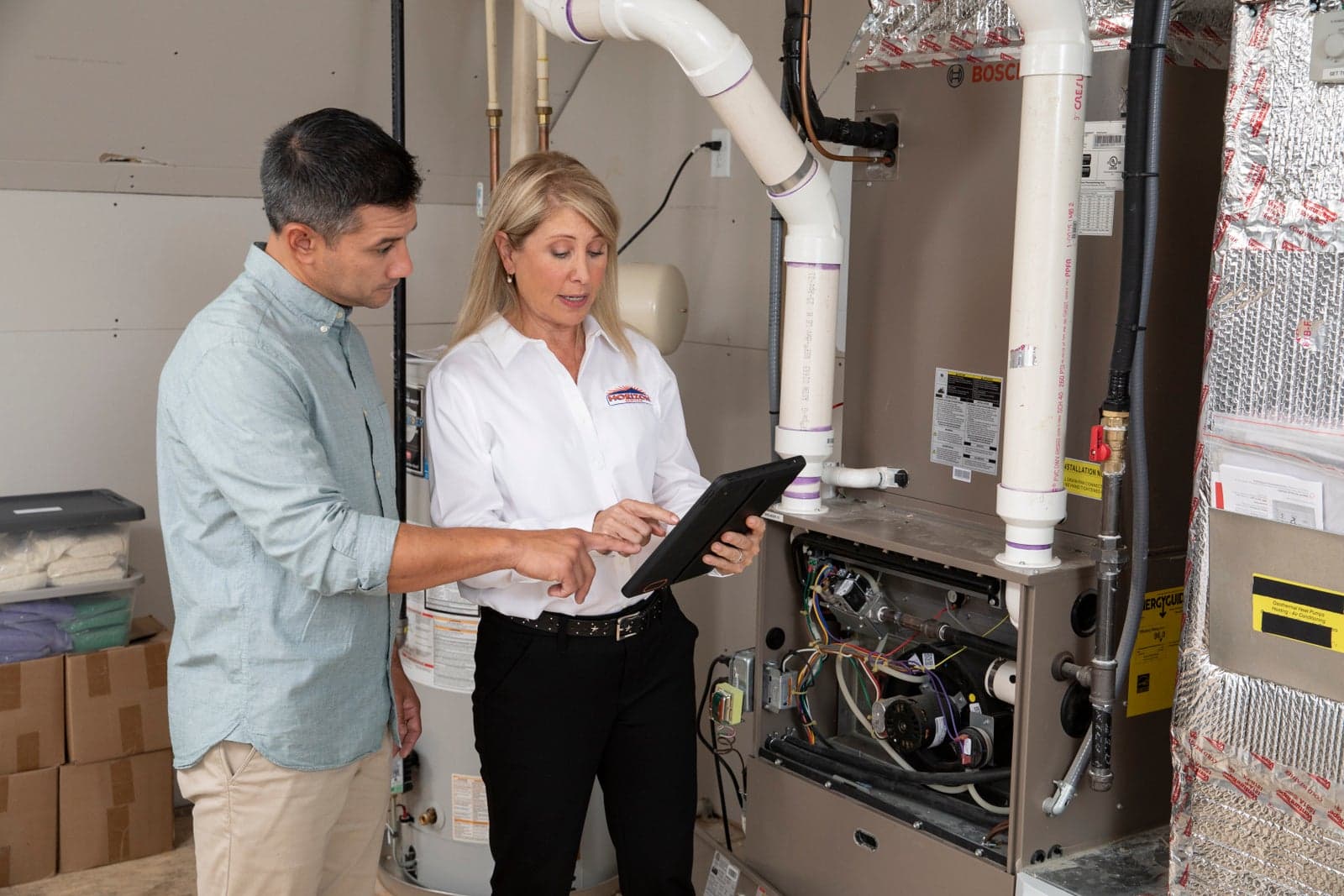
An 80% AFUE furnace sends about a fifth of the fuel you buy out through the flue. A 96% furnace sends about a twenty-fifth. For the same heat delivered into the house, the high-efficiency unit burns noticeably less gas. Whether that difference justifies the upgrade depends on how many hours your furnace actually runs each winter and what your house has to change to accept a condensing appliance.
On this page:
What AFUE actually measures
80% vs 96%, side by side
What decides whether the upgrade pays off here
Two-stage vs modulating
Radiator heat vs forced air, and does brand matter
The 2028 federal rule, and gas safety
FAQs
Two quotes land on your kitchen table. One is an 80% furnace. One is a 96%. The second costs more and the salesperson says it pays for itself.
Maybe. The efficiency difference is real and it is not marketing. But the size of the benefit is set by how many hours the equipment runs, and a Delaware Valley winter puts fewer hours on a furnace than a Vermont one does.
So the honest version of this comparison is not a verdict. It is a set of conditions, and most of them are about your house rather than the equipment.
What AFUE Actually Measures
AFUE stands for annual fuel utilization efficiency. It is a seasonal ratio: how much of the fuel energy you paid for ends up as heat inside the house, averaged across a heating season.
The useful way to read it is backwards. An 80% furnace puts roughly one unit in five out of the flue as hot exhaust. A 96% furnace puts roughly one in twenty-five out. Everything else about the two machines follows from what happens to that flue heat.
Our explainer on SEER, AFUE and HSPF ratings covers how the rating is derived if you want the full version.
80% vs 96%, Side by Side
These are the differences that show up in a real installation, not on a brochure.
Spec | 80% AFUE | 96% AFUE |
Heat exchangers | One | Two, the second one extracting heat from the exhaust |
What happens to flue heat | Leaves hot, up the chimney | Cooled until water vapour condenses out of it |
Venting | Metal vent into a chimney or B-vent | Plastic pipe, usually out a sidewall |
Chimney involved | Yes, in most older homes here | Usually abandoned by the furnace |
Condensate | None | A drain is required, and often a neutralizer |
Effect on a shared water heater | Shares the flue | Leaves the water heater venting alone |
Typical blower pairing | Single-speed or multi-speed | Often variable-speed ECM |
Effect on the gas bill | Baseline | Less fuel burned for the same heat delivered |
Best fit | Mild climates, short occupancy plans, difficult venting | Long heating seasons, long occupancy plans, existing sidewall vent path |
What Decides Whether the Upgrade Pays Off Here
Four variables move this, and none of them are the sticker.
Annual Run Hours
Efficiency only saves you money while the burner is lit. Delaware, southeastern Pennsylvania and South Jersey have a genuine heating season, but a shorter one than northern New England, which means the same percentage difference is applied to fewer hours of operation. A bigger, draftier, older house runs more hours and gets more out of the upgrade. A small, well-insulated one gets less.
How Long You Plan to Stay
A furnace installed in a house you will sell in three years does its saving for someone else. If you are staying twenty years, the arithmetic looks entirely different, and the equipment will likely still be running at the end of it.
What Your Gas Actually Costs You
The delivered rate per therm is set by your utility and it moves. We do not publish rates and no honest contractor should quote you one from a blog post. Pull twelve months of your own bills before you decide, because your consumption history is the only input to this calculation that is specific to you.
What the Installation Has to Change
This is the variable most comparison articles skip entirely, and in our housing stock it is often the decisive one. A condensing furnace is a different appliance to install, not just a more efficient one.
What Changes About the Installation
Three things change when you go condensing. All three should appear on a complete quote.
Venting
Because a 96% furnace cools its exhaust below the point where water condenses out of it, that exhaust is no longer hot enough to rise up a masonry chimney. It vents through plastic pipe, and that pipe has to reach an approved termination point, usually through a sidewall, with clearances from windows, doors and grade. In a rowhouse or a tight lot, finding that path is real work.
Condensate
The condensed water has to go somewhere. That means a drain line to an approved point, a condensate pump if the furnace sits below the drain, and in many jurisdictions a neutralizer, because the condensate is mildly acidic.
The Orphaned Water Heater
Here is the one that surprises people. In a lot of homes in our area, the furnace and a natural-draft water heater share a single masonry chimney. Pull the furnace off that chimney and the water heater is left venting alone into a flue sized for two appliances.
That can mean weak draft, exhaust spilling into the basement, and moisture damage inside the chimney. The remedies are a properly sized flue liner or moving to a power-vent or direct-vent unit. Either way it belongs in the scope of the job, not in a phone call three weeks later. See water heater replacement for what that involves.
If you are weighing two quotes right now, the fastest way to find out which one is complete is to ask both contractors how they are handling venting, condensate and the water heater. Our furnace replacement visits start with a load calculation and a look at the venting path. Call 1-800-642-4419.
Two-Stage vs Modulating
Efficiency and staging are two separate specs, and people conflate them constantly. AFUE tells you how much fuel becomes heat. Staging tells you how the furnace delivers that heat across a winter.
Single-Stage
One firing rate, full output, on or off. On a 40-degree evening it delivers the same blast it would on a 10-degree night, satisfies the thermostat quickly and shuts down. That is what short cycling is, and it is why the far bedroom stays cold while the hallway overheats.
Two-Stage
Two fixed firing rates. The furnace spends most of the season on low fire, which produces longer, gentler run cycles, and steps up to high fire only when the weather demands it. For most homes this is where the comfort difference becomes obvious.
Modulating
The burner varies its firing rate continuously in small increments, so output tracks the actual heat loss of the house rather than stepping to meet it. The result is very long, very steady, very quiet run cycles and tighter temperature control.
Why the Blower Matters as Much as the Burner
The thing people notice and describe as “it just feels better” is usually the blower, not the burner. A variable-speed ECM blower ramps slowly, runs at low speed for long periods, mixes air between rooms and eliminates the start-stop gust. A modulating burner paired with a single-speed blower gives you much less of that.
When you compare quotes, ask what blower motor is in the unit. It is a specification worth as much attention as the AFUE number.
Who Should Choose Which
Two-stage is the sensible default for most homes: a single-storey house, a tight budget, a rental, or a property you expect to sell within a few years.
Modulating earns its keep when you have real comfort complaints. Rooms that never match each other, a two-storey house with a hot upstairs, someone home all day, or a household that notices system noise. Those are the conditions where people say the upgrade was worth it.
Radiator Heat vs Forced Air When Replacing an Old System
If you have radiators and they work, keep them.
Hydronic heat is quiet, it does not blow dust around, and it holds a very even temperature. Ripping out a functioning distribution system to install ductwork in a house that has never had any is expensive, disruptive, and frequently ends in worse comfort than what you started with. Replacing the boiler alone is usually the better project.
Forced air makes sense in three situations: the ducts already exist, you want central cooling and have nowhere to put it, or the boiler and the distribution piping are both at the end of their lives at the same time.
Does the Furnace Brand Actually Matter?
Less than the installation does, and we will say that as a company with dealer relationships of our own.
In order, the things that decide how a furnace performs and how long it lasts are: a correct room-by-room load calculation and sizing; duct condition and static pressure; commissioning quality, meaning gas pressure set, airflow verified and combustion checked; who honours the warranty locally; and parts availability in your area.
Brand ranks below all five. A premium modulating furnace that is oversized and connected to restricted ductwork will underperform a mid-tier two-stage unit that was sized properly and commissioned correctly, every winter, for as long as both are running.
Horizon installs Daikin and Rheem equipment and services all makes and models, including furnaces we did not sell. You can see the equipment lines we install on our site. If a contractor cannot explain why they sized the system the way they did, the brand on the cabinet is not the problem you should be worried about. Our list of questions to ask an HVAC contractor is a useful thing to have in hand.
The 2028 Federal Rule, and What Happened to the Tax Credit
The Department of Energy's December 2023 final rule sets a minimum of 95.0% AFUE for non-weatherized gas furnaces and mobile home gas furnaces, with compliance required for units manufactured on and after December 18, 2028. The rule was upheld on appeal.
Read that carefully, because it is widely misreported. It applies to what manufacturers may build, not to what is sitting in your basement. Nobody is required to replace a working 80% furnace, and 80% units will continue to be serviceable for years after the date.
On incentives: the federal 25C energy efficient home improvement credit terminated for property placed in service after December 31, 2025 under PL 119-21. It is not available for a furnace installed today. What may still exist are utility and manufacturer programs, which change without notice and vary by which gas utility serves you. Check current offers and rebates and ask your contractor to confirm anything in writing at the time of quote.
If You Smell Gas Near the Furnace
Leave the building first. Do not flip switches, do not unplug anything, and do not use a phone inside the house.
From outside, call 911 and your gas utility's emergency line. Do not go back in until the utility or the fire department has cleared the house.
Our role starts after that: locating the source, testing the gas line, inspecting the heat exchanger and confirming the system is safe to operate again. See what to do if you smell gas in your home and gas leak detection.
Why Choose Horizon Services for Furnace Replacement
Horizon serves Delaware, southeastern Pennsylvania, South Jersey and parts of Maryland, and the housing stock here is why our replacement quotes start with the venting path and the chimney rather than with a model number.
We install Daikin and Rheem equipment, service all makes and models, and size every replacement from a room-by-room load calculation rather than matching what came out.
See heating services or gas furnaces, ask about Comfort360 membership for seasonal maintenance, or call 1-800-642-4419 to schedule a free replacement estimate.
80 vs 96 AFUE Furnace FAQs
80 versus 96 AFUE furnace, what is the real difference on gas bills?
An 80% furnace loses roughly a fifth of its fuel energy out the flue and a 96% furnace loses roughly a twenty-fifth, so the high-efficiency unit burns less gas for the same delivered heat. How much that shows up on your bill depends on your run hours, your home's heat loss and your utility's delivered rate. Pull a year of bills before deciding.
Two stage furnace vs modulating, is the upgrade noticeable?
Yes, but what you notice is comfort rather than the bill. A modulating burner varies output continuously so run cycles are long and steady, which evens out rooms and reduces noise. Two-stage gives you most of that at lower cost. Ask what blower motor is fitted, because a variable-speed blower drives much of the improvement.
Will a properly sized modern system heat better than my oversized old one?
Almost always. Oversized equipment short cycles: it satisfies the thermostat quickly, shuts off, and leaves far rooms cold while the hallway overheats. A correctly sized system runs longer at lower output, which mixes air and evens temperatures. Insist on a room-by-room Manual J load calculation rather than a like-for-like swap.
Radiator heat versus forced air when replacing an old system?
Keep the radiators if the distribution is sound, because replacing just the boiler is far less disruptive than installing ductwork in a house that has never had any. Move to forced air when ducts already exist, when you want central cooling and have no path for it, or when the boiler and the piping are both at end of life.
Heat pump versus furnace repair costs, which usually runs higher?
A single heat pump repair typically runs higher than a single furnace repair, because refrigerant-circuit work adds recovery, evacuation and charge verification labor that furnace repairs do not involve. Across a full season the picture evens out, since heat pumps usually need fewer repair visits than an aging gas furnace does.
We just smelled gas near the furnace, who do we call first?
Leave the building first, then call 911 and your gas utility's emergency line from outside. Do not flip switches, unplug anything or use a phone indoors, and do not re-enter until the utility or fire department clears the house. Call Horizon afterward to find the source and inspect the heat exchanger.
Related Articles
What do you need help with today?
Heating
No heat, strange smells, rising bills? We repair and replace heating systems to keep your home reliably warm.
Air Conditioning
AC blowing warm air? Uneven cooling in your rooms? We fix cooling issues fast and keep your system running smoothly all summer.
Plumbing
Our highly trained plumbers handle it all, from leaky faucets to full system installations and repipes.
Electrical
The smartest team in town. You need repair, installations, wiring, inspections, lighting — you name it.