
Is Flexible Ductwork a Good Choice for Your Home
Last updated: August 2026
Flex duct is a legitimate, code-approved choice for short connector runs and tight spaces, at a fraction of sheet metal's cost. Its weakness isn't the material; it's installation. Crushed runs, sagging spans, and sharp bends quietly strangle airflow, which is why most flex duct complaints trace to how it was hung, not what it's made of. For trunk lines and long straight runs, rigid metal still wins.
On this page:
What Flex Duct Is
Flex vs. Rigid, Category by Category
R-Value and Lifespan
Why Installation Decides Everything
When Flex Wins and When Rigid Wins
Signs Your Ducts Are the Problem
FAQs
When upgrading or repairing an HVAC system, the ductwork rarely gets the attention the shiny equipment does. And yet the ducts decide how much of the comfort you're paying for actually arrives in your rooms.
If your contractor has proposed flexible ductwork, or you've peered into your attic and found silver coils snaking through the rafters, the natural question is whether flex duct is a good choice or a corner being cut. The honest answer: it depends almost entirely on where it's used and how it's installed.
What Is Flex Duct?
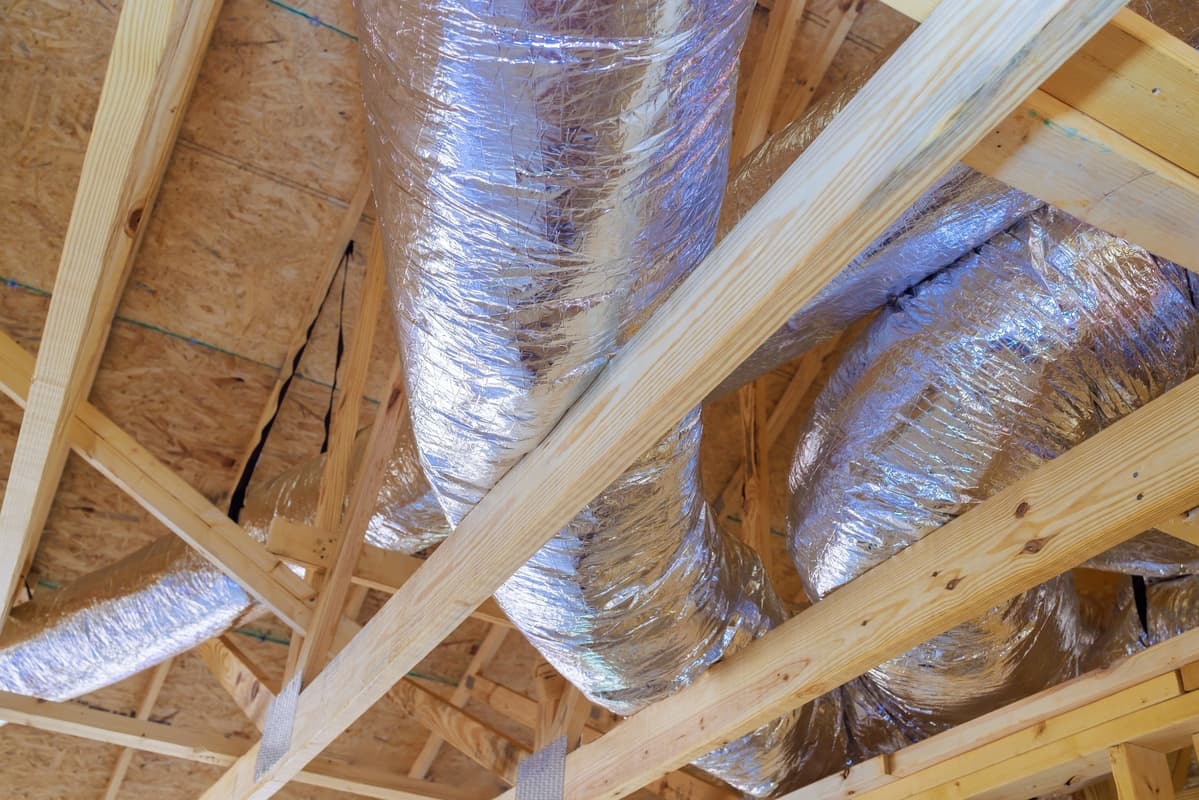
Flexible ductwork is a factory-made sandwich of three layers: a helical steel wire coil supporting a polymer inner liner (the tube air actually travels through), wrapped in fiberglass insulation, jacketed in a plastic or foil vapor barrier. It typically comes in 25-foot lengths and residential diameters from 4 to 20 inches.
It earns its name honestly. Flex bends around joists, snakes through tight framing, and installs in a fraction of the time sheet metal fabrication takes.
Quality flex duct carries a UL 181 listing, which makes it fully code-legal when installed to the manufacturer's instructions. That last clause, when installed to the manufacturer's instructions, is where this entire topic lives, as you'll see.
Flex Duct vs. Rigid Ductwork: Category by Category
Category | Winner | Why |
Cost | Flex duct | A fraction of sheet metal per installed foot, with less material cost and far less labor |
Installation speed & tight spaces | Flex duct | Bends around framing that rigid can't be routed through without custom fabrication |
Airflow | Rigid | Smooth metal interior; flex's ribbed liner adds friction even when perfectly installed |
Durability | Rigid | Sheet metal shrugs off what punctures, crushes, or tears flex |
Lifespan | Rigid | 20–30+ years vs. roughly 10–25 for flex depending on conditions |
Noise | Flex duct (slightly) | The insulated liner damps equipment and airflow sound rigid metal can transmit |
Serviceability | Rigid | Metal can be cleaned aggressively; damaged flex gets replaced, not repaired |
Best use | Tie, by role | Rigid for trunks and long runs; flex for short branch connections and awkward spaces |
The Numbers That Matter: R-Value and Lifespan
Two figures do a lot of deciding here.
Insulation: flex duct is sold in ratings from roughly R-4.2 to R-8. Inside conditioned space, R-4.2 is acceptable. In an unconditioned attic or crawlspace, where most Delaware, Pennsylvania, New Jersey, and Maryland flex duct actually lives, R-8 is the number to insist on. Every degree lost through a duct wall in a 130°F July attic is comfort you paid to make and never received.
And a caveat the label won't tell you: compressing flex duct's insulation, whether by squeezing it through a tight framing bay or cinching a support strap too hard, can cost it a large share of its effective R-value. The install determines whether you get the R-value you bought.
Lifespan: properly installed flex typically serves 15–25 years, sagging toward 10–15 in punishing attic conditions. Rigid metal runs 20–30 or more. If your flex ductwork went in when your home was built in the 1990s or 2000s, it's due for an honest look regardless of how it feels downstairs.
Installation Is a Determining Factor.
Home-inspection standards for flex duct are specific:
Horizontal runs supported at least every five feet (four for some products), vertical runs every six.
Support straps at least 1½ inches wide so they don't knife into the insulation.
Sag limited to about half an inch per foot between supports.
Bends no tighter than one duct diameter.
The duct routed through openings at least as large as its inner core, never pinched.
Connections matter just as much: collars, mastic sealant, and mechanical draw bands. Not the cloth "duct tape" that, despite its name, fails on ducts within a few years.
Why be this fussy? Because the losses are enormous and invisible. A flex run compressed to two-thirds of its diameter can lose a huge share of its airflow. Each unnecessary sharp bend adds resistance equivalent to yards of straight duct. And duct leakage in a typical home wastes a meaningful fraction of every conditioned-air dollar, often into an attic nobody lives in.
When a technician says "your ductwork is strangling your system," this list is usually what they found.
Wondering what's actually holding up your flex duct right now? That's exactly the right question, and it takes a flashlight and a trained eye rather than guesswork. Horizon Services has served Delaware, Southeastern Pennsylvania, South Jersey, and parts of Maryland since 1987, and our technicians evaluate ductwork condition as part of air conditioning service visits — backed by our on-time guarantee: if we're even a minute outside the window, you don't pay for the service call. Call 800-642-4419 with your ductwork questions.
When Flex Is the Right Call, and When Rigid Wins
Choose flex duct for: the short branch runs connecting a rigid trunk to individual room boots; retrofits and additions where fabricating metal through closed framing would cost a fortune; tight, awkward chases rigid simply can't turn through; and situations where a modest budget has to cover the whole system.
Choose rigid for: trunk lines and main supply runs; long straight distances; high-static systems; and anywhere the duct might be stepped on, stored against, or otherwise live a hard life.
The best residential systems usually aren't either/or. They're rigid trunks with short, well-supported flex branches: metal where airflow and durability matter most, flex where geometry and economics favor it.
And to bust the absolutist take you'll find online: "flex duct is bad" is a myth. UL 181-listed flex, sized right and installed to spec, is fully code-compliant and performs well for decades. Badly installed flex is bad, which is a different claim.
Signs Your Ductwork, Not Your Equipment, Is the Problem
Before blaming (or replacing) the machine, check for the duct signature: weak airflow at some registers while others blast; hot and cold rooms the thermostat can't reconcile; whistling or rumbling from runs starved or slammed by pressure; and high bills with healthy equipment, which is the leaked-into-the-attic tax.
Excessive dust belongs on that list too. It often means a torn liner or leaky return pulling from the attic, which is an air-quality problem as much as a comfort one. That's where indoor air quality solutions enter the conversation.
Diagnosis routes through the systems the ducts serve. Our AC repair and heating services teams measure temperature splits and static pressure to separate a duct problem from an equipment problem in one visit.
On fixes: a torn section, failed boot connection, or loose collar is repairable, while widespread crushing, saturated insulation, or a rodent-colonized run means replacing those sections. Nationally, ductwork work ranges from modest repair costs to a real project for full replacement.
(Figures vary widely by home; treat online averages as orientation, not quotes.) For the larger jobs, flexible financing options can spread the cost into manageable payments.
Contact Horizon Services with Your Ductwork Questions!
Whether you're weighing flex against rigid for a renovation, suspicious about what four decades of summers have done to the silver coils in your attic, or just tired of one room that never cools, Horizon Services can give you a straight answer.
We've served Delaware, Southeastern Pennsylvania, South Jersey, and parts of Maryland since 1987: nearly 40 years, 700+ employees, a BBB A+ rating and a BBB Torch Award for Marketplace Ethics, with "Always On-Time, Guaranteed" scheduling, no emergency, holiday, weekend, or after-hours fees, and AC services guaranteed for two full years.
Have a technician evaluate your ductwork at your next air conditioning service visit. Call 800-642-4419 or schedule online today.
Frequently Asked Questions
How long does flexible ductwork last?
Properly installed and living in reasonable conditions, 15–25 years; in a brutal unconditioned attic, closer to 10–15. Rigid metal ductwork runs 20–30 years or more. If your flex duct dates to your home's construction decades ago, an inspection is worth scheduling even if comfort seems fine, since degradation is gradual and invisible from the living room.
Does flex duct reduce airflow?
Somewhat, inherently: its ribbed inner liner adds friction that smooth metal doesn't have. But the dramatic airflow losses come from installation faults. Compression, sag, and sharp bends can cut a run's delivery drastically. Well-supported, fully extended flex on short branch runs performs close to spec; crushed flex anywhere performs terribly.
Is flex duct bad? Why do some contractors dislike it?
The material isn't bad. UL 181-listed flex duct is code-approved and works well for decades when installed to standard. Contractors who hate it have usually spent careers finding it crushed, sagging, and taped instead of clamped. The fair statement: flex duct punishes sloppy installation more than rigid does, so the installer matters more than the material.
What R-value flex duct do I need in an attic?
R-8, the highest standard rating, for any duct running through an unconditioned attic or crawlspace in the mid-Atlantic. R-4.2 is acceptable only inside conditioned space. And insist on installation that doesn't compress the insulation, since squeezing flex duct can forfeit much of the R-value you paid for.
Can flexible ductwork be cleaned or repaired?
Carefully, and only sometimes. The polymer liner is too delicate for the aggressive cleaning rigid metal tolerates, and a torn or crushed section of flex is replaced rather than patched. Fortunately, sectional replacement is quick and inexpensive. Failed connections and boots can be resealed properly with mastic and draw bands.
How much does flexible ductwork cost?
Materials run a few dollars per foot, a fraction of fabricated sheet metal, which along with faster installation is why flex is the budget-friendly choice for branch runs. Whole-home numbers vary too widely by layout and access for a useful average, so get an in-home quote. Financing can spread larger ductwork projects into monthly payments.
Related Articles
What do you need help with today?
Heating
No heat, strange smells, rising bills? We repair and replace heating systems to keep your home reliably warm.
Air Conditioning
AC blowing warm air? Uneven cooling in your rooms? We fix cooling issues fast and keep your system running smoothly all summer.
Plumbing
Our highly trained plumbers handle it all, from leaky faucets to full system installations and repipes.
Electrical
The smartest team in town. You need repair, installations, wiring, inspections, lighting — you name it.